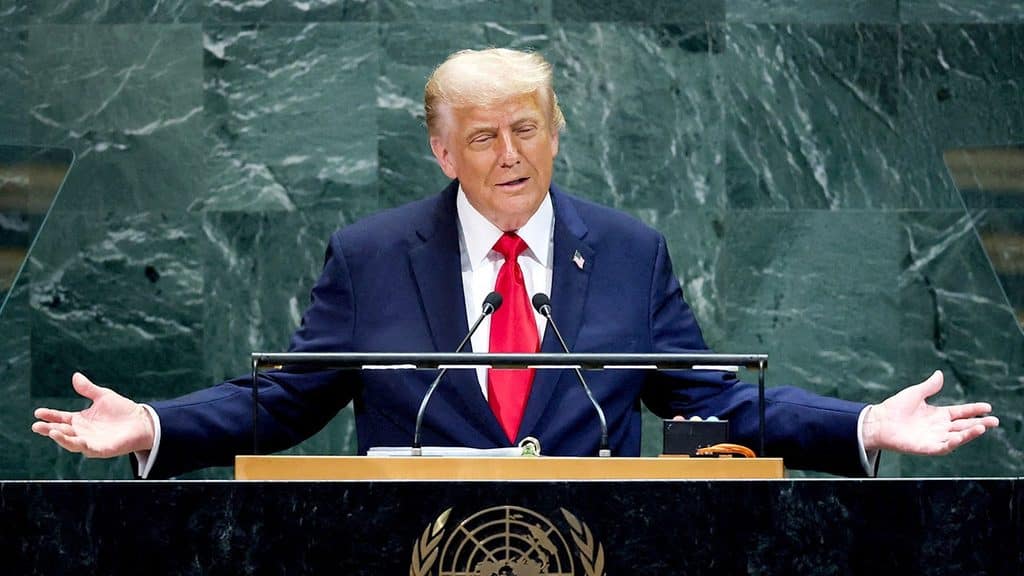
Amsterdam, September 23, 2026 – When Luiz Inácio Lula da Silva opened the UN General Assembly’s general debate on September 22, warning against foreign interference in Brazil’s election, and Donald Trump followed roughly fifteen minutes later, the spectacle playing out in New York carried a particular sting for Uruguay. Montevideo has spent much of 2026 trying to get a seat at the very table both leaders are fighting over: the fight against organized crime and drug trafficking in Latin America. It has largely been left standing outside the room.
A Coalition That Skipped Uruguay — and Brazil
In March 2026, Trump launched the “Shield of the Americas” (Escudo de las Américas) at a summit in Florida — a coalition of politically aligned governments committing to use lethal military force against drug cartels, with Trump declaring the goal was to destroy criminal networks “once and for all.” Roughly 17 to 19 countries signed on, including Argentina, Chile, Colombia, Ecuador, Paraguay, and several Central American and Caribbean states.
Donald Trump
Uruguay was not among them. Neither was Brazil. Both were grouped, along with Mexico, Canada, Venezuela, Nicaragua and Cuba, among the “nominally left-of-center” governments that were not invited to join.
President Yamandú Orsi’s reaction was telling. Asked about the exclusion, he called it simply “raro” — strange — noting that the topic had come up among fellow presidents in Chile, where one leader had reportedly asked aloud, in front of the group, why Uruguay hadn’t been invited given that the subject was precisely organized crime and drug trafficking. Orsi added that Uruguay would be “dispuesto” — willing — to join if asked, arguing that on the substance, the diagnosis is shared even if Uruguay wasn’t part of the announcement.
For a small country of 3.4 million wedged between Brazil and Argentina, that omission is not a minor diplomatic footnote. Brazilian gangs like the Primeiro Comando da Capital (PCC) — which the US has since designated a foreign terrorist organization alongside Rio’s Comando Vermelho — have expanded their international footprint into neighboring countries, with reports identifying Paraguay, Venezuela, Bolivia and Uruguay as particular points of penetration. Organized crime is not an abstraction for Montevideo; it is a border-adjacent reality, one made vivid earlier this year when Uruguay thanked Bolivia and Paraguay for cooperating in the capture of Uruguayan drug trafficker Sebastián Marset.
Uruguay’s Answer: Build the Table It Wasn’t Invited To
Rather than simply protest the snub, Orsi’s government has spent 2026 positioning Uruguay as a broker for a different, less militarized version of the same fight. When Orsi assumed the rotating presidency of the Community of Latin American and Caribbean States (CELAC) in March, he devoted part of his inaugural address to organized crime, calling it a “challenge that cuts across all” member countries and urging a “shared responsibility” — implicitly offering CELAC as an inclusive alternative to Washington’s coalition-of-the-willing model.
That positioning continued in New York during UN General Assembly week. Uruguay’s agenda combined a CELAC forum emphasizing security and anti-trafficking cooperation “above ideological differences” with direct, practical diplomacy: Orsi requested — and got — a bilateral meeting with Lula just two weeks before Brazil’s election, a 45-minute sit-down that also touched on cross-border infrastructure and a Chinese beef-export quota Lula agreed to cede to Uruguay. Notably, despite Orsi’s own Frente Amplio party’s sympathies favoring Lula over Flávio Bolsonaro, Orsi avoided publicly taking sides in Brazil’s race — a small but deliberate signal of Uruguay’s preference for staying above the fray between Brasília and Washington.
At the same time, Washington hasn’t abandoned the bilateral security relationship. The US ambassador in Montevideo, Lou Rinaldi — a longtime personal friend of Trump’s — has continued pushing intelligence-sharing and security cooperation with Uruguayan police despite the country’s absence from the Shield of the Americas, even as friction points remain, including US pressure around using military-style vehicles for domestic policing.
Reading Between the Lines of Two Speeches
From Montevideo’s vantage point, the Lula-Trump exchange at the UN reinforced exactly the dynamic Uruguay has been navigating for a year. Lula devoted much of his address to warning against “hegemonic temptations” from “the world’s greatest power” and insisted Brazil “doesn’t fit in anyone’s backyard,” a formulation squarely rejecting the sphere-of-influence logic that the Shield of the Americas, in Uruguayan eyes, implicitly represents. He called for “partners with a positive agenda” rather than external pressure — language that echoes almost precisely what Orsi has been requesting from Washington on the trafficking issue: inclusion and cooperation, not exclusion and unilateral military postures.
Trump, for his part, has increasingly framed counter-narcotics policy in the region as a matter warranting military force rather than law enforcement, including a campaign of lethal strikes on alleged trafficking vessels in the Caribbean and eastern Pacific that has killed close to 150 people, according to reporting on the campaign, without public confirmation of victims’ identities. That approach sits uneasily with the CELAC framing Uruguay has championed, which stresses intelligence-sharing, financial-crime cooperation and multilateral coordination over strikes.
The Uncomfortable Middle
What emerges is a small country trying to occupy an increasingly narrow middle ground. Uruguay shares Washington’s stated diagnosis — that Brazilian, Venezuelan and other regional criminal networks pose a serious cross-border threat — closely enough that Orsi says there’s no real disagreement “on the problem.” But it has so far been excluded from the coalition built to address it, for reasons tied more to ideological alignment than operational logic, while simultaneously trying to keep functional, non-partisan relationships with both Lula’s Brazil and Trump’s Washington intact.
That balancing act will only get harder. Brazil heads into a first-round vote on October 4 that could replace Lula with a Trump-aligned government under Flávio Bolsonaro, which would reshape the regional security landscape Uruguay is trying to help coordinate. Whatever the outcome, Montevideo’s experience this year — invited to neither Trump’s coalition nor able to fully escape its consequences — is likely to remain the story of a country whose stakes in the fight against organized crime are undeniable, even when its seat at the table isn’t guaranteed.