When Ueno Bank froze nearly 3 million accounts, Paraguay’s government fell in four days. Brazil’s Banco Master scandal has dragged on for a year. Is speed the same as justice?
eyesonbrasil
At dawn on Tuesday, November 3, Paraguay’s central bank ordered the intervention and dissolution of Ueno Bank. Its solvency index had fallen below half the legal minimum. The app, cards and services went dark at once. Ueno had 2.9 million clients in a country of 6.1 million people, equal to about 60% of the adult population. It was the fifth-largest bank by deposits and the first by customers. Queues formed outside branches, and protests broke out in Asunción that night.
The damage reached the state too. Ueno held roughly US$850 million from public bodies, including the pension and health institute IPS. Fixed-term deposits stopped paying out.
What went wrong
The central bank’s investigation found loans to companies tied to Grupo Vázquez, the bank’s controlling group, which led to defaults and weakened liquidity. Prosecutors say that in June 2026 Ueno transferred a US$74.4 million loan portfolio to a related company that may have been financed indirectly by the bank itself, possibly hiding its true financial position. Only months earlier, in March, Ueno had issued US$350 million in international bonds at a rate below 7%.
The political bomb
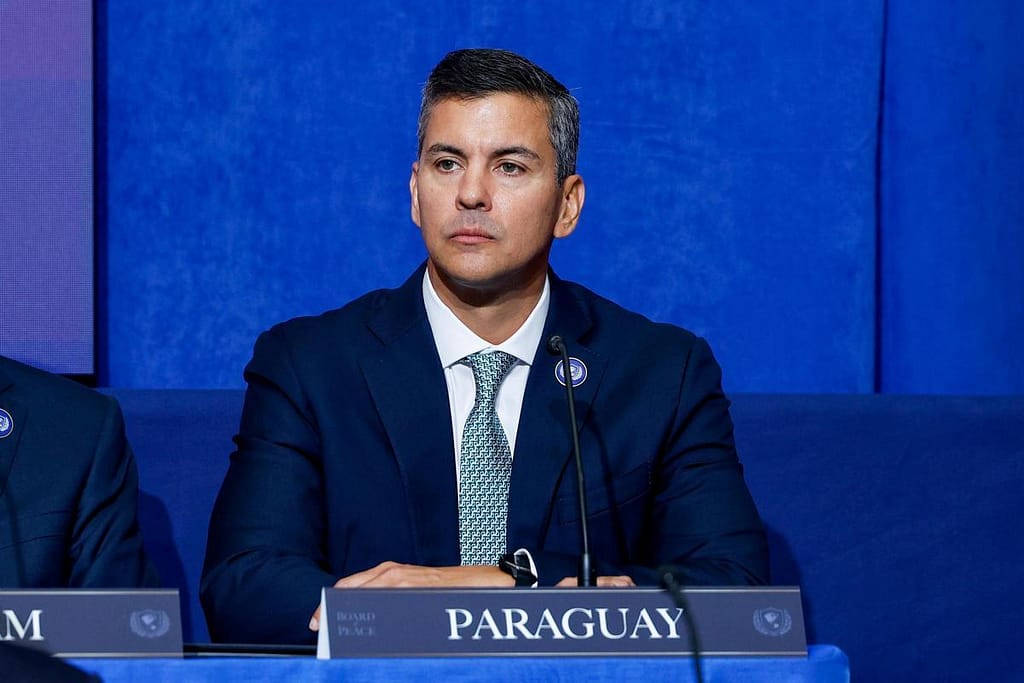
The link to power is what turned a bank failure into a regime crisis. Santiago Peña was a shareholder of Ueno until March 2025. Carlos Carvallo, the head of the central bank that was supposed to supervise it, had chaired Ueno until July 2023. When the intervention was announced, Peña asked Carvallo to resign and named a replacement.
Santiago Peña
Then things moved fast. Prosecutors indicted 27 people, including eight executives, and requested pretrial detention for the largest shareholder, Miguel Vásquez. Congress passed an emergency law in record time, allowing deposit-guarantee advances of up to 40 monthly minimum wages per depositor, about US$19,800. Opposition and dissident lawmakers filed an impeachment motion with 35 signatures. They accused Peña of poor performance, conflict of interest, regulatory manipulation, diversion of pension funds and institutional cover-up for the central bank.
On Thursday Peña announced his resignation. Congress could not accept it without a quorum, so impeachment continued. On Friday, all 44 senators present voted to remove him, making him the second Paraguayan president impeached since the end of the dictatorship, after Fernando Lugo in 2012. Hours later he was placed under house arrest on suspicion of abuse of trust and influence peddling, among other charges. Peña has denied wrongdoing. Vice President Pedro Alliana was sworn in and is himself under investigation in connection with the bank.
And in Brazil?
The Master case has a longer, murkier arc. Daniel Vorcaro was arrested in November 2025, and the Federal Police’s Operation Compliance Zero has run through multiple phases. On October 31, 2026, the PF delivered its first indictment, describing Vorcaro as the leader of a criminal organization that defrauded the financial system. On November 6 the Supreme Court’s president homologated the first plea deal in the case, from the former owner of the fund manager Reag.
But no justice has been charged. Six of the Supreme Court’s ten sitting justices were cited by name, or had relatives cited, in connection with the banker. The PF’s October indictment left them out, though by law justices cannot be indicted directly by the police. A historic plenary session began judging whether to investigate Alexandre de Moraes, but it was postponed after a request for review, and the materials released remain the subject of investigation and institutional controversy rather than proof of wrongdoing. Dias Toffoli handled the case until February, under heavy criticism over secrecy and over reports linking his family to funds tied to Master, before André Mendonça took over.
Did Paraguay handle it better?
On speed and visible accountability, yes. In four days Paraguay intervened, jailed or charged bank executives, paid depositors, removed its central bank chief and its president. The pressure came from a simple fact: roughly one in three people had money in Ueno, so the crisis was personal for voters. Brazil’s scandal is larger in its institutional reach but more abstract for ordinary citizens, and it implicates the very court that must judge it.
But speed is not the same as justice. Paraguay’s cleanup is days old; charges are allegations, Peña denies wrongdoing, and critics note he fell only after he lost his party’s support. The warning signs, a supervisor who came from the bank it oversaw, existed for years. Brazil’s slower path has at least produced an indictment of the alleged mastermind, even if the Supreme Court’s own members remain untouched.
The sharpest lesson may be that both countries failed at the same earlier stage: supervision. What separates them is how the political system reacted once the money disappeared.
Sources: Infobae, El Financiero, CNN en Español, Diario Socialista (EFE), Gazeta do Povo, Diário de Pernambuco, O Globo (via Tribuna do Sertão), Congresso em Foco, Wikipedia.