


Inside Brazil’s Ethanol Gamble

What the Government’s Own Numbers Don’t Show
eyesonbrasil
On August 1, 2026, Brazil’s gas pumps quietly started dispensing E32 — gasoline with 32% ethanol, up from 30%. Six weeks later, on September 18, the government authorized testing to push that further, to 35%. Officially, this is presented as a routine technical evolution. A closer look at the record shows something messier: a decision the government’s own regulator calls economically driven as much as technical, a vehicle-makers’ association that says the safety case hasn’t actually been made, and a federal prosecutors’ office that already tried to block it in court.
The official story
The Ministry of Mines and Energy says the science backs the E32 increase. Testing coordinated by the ministry and carried out by the Instituto Mauá de Tecnologia evaluated light vehicles and motorcycles, in both lab and real-world conditions, checking engine performance, drivability, cold starts, fuel consumption and emissions. The ministry says those tests found no relevant impact on how vehicles function, and that gasoline with 32% ethanol performed similarly to the 30% blend already on the market — including in gasoline-only engines specifically checked for problems. On that basis, the National Energy Policy Council approved E32 for an initial 180-day period.

The automakers disagree — on the record
That’s not where the story ends. ANFAVEA, the industry group representing Brazil’s vehicle manufacturers, publicly contested the studies the government used to justify E32, arguing the ensaios don’t actually demonstrate the new mixture is safe — this despite ANFAVEA itself supporting biofuels in principle. That’s a notable break: it isn’t outside critics or independent mechanics disputing the government’s numbers, it’s the industry that builds the engines in question.
This isn’t a new pattern, either. Brazil has raised the mandatory ethanol blend repeatedly since the mid-2010s — from 25% to 27.5%, then to 30%, now to 32% — and nearly every step has followed the same choreography: the government moves forward, and ANFAVEA flags that durability testing (which requires running vehicles roughly 100,000 km to check long-term wear on engine and exhaust components) hasn’t caught up with the policy decision. In 2015, ANFAVEA’s own president said the durability testing simply hadn’t finished on schedule. A decade later, the objection sounds much the same.
Prosecutors weighed in — and lost
The clearest sign this wasn’t a clean technical consensus: after E32 was approved, Brazil’s Federal Public Prosecutor’s Office (MPF) went to court seeking to suspend the mandatory ethanol increase, arguing the technical studies didn’t provide sufficient assurance. More pointedly, prosecutors alleged the government leaned on research conducted for the previous blend level to try to validate the new, higher one — rather than commissioning a fresh durability study for 32% itself. That request for a court injunction did not stop the rollout; E32 went into effect as scheduled on August 1.
A minister who admits it’s a judgment call
Perhaps the most revealing detail is what the Minister of Mines and Energy, Alexandre Silveira, said himself at the time of approval. Asked about pushing to E35, he made clear the decision isn’t purely a matter of waiting for lab results: further increases depend on economic viability as much as testing outcomes, and the blend could rise or fall depending on how conditions play out. That’s a significant admission — it confirms what an Inmetro technician let slip back in 2014, when he called an earlier blend decision “more political than technical,” a comment the sugarcane industry’s own lobby group publicly pushed back on at the time.
That “economic” dimension isn’t hidden. More ethanol in the blend cuts Brazil’s gasoline import bill and props up demand for a politically powerful, largely Brazilian-owned sugarcane-ethanol industry. None of that makes the policy wrong on its merits — energy independence and biofuel support are legitimate goals with real defenders — but it does mean the blend percentage has never been decided by engine-durability data alone, and the government’s own minister says so.
What’s actually still unknown
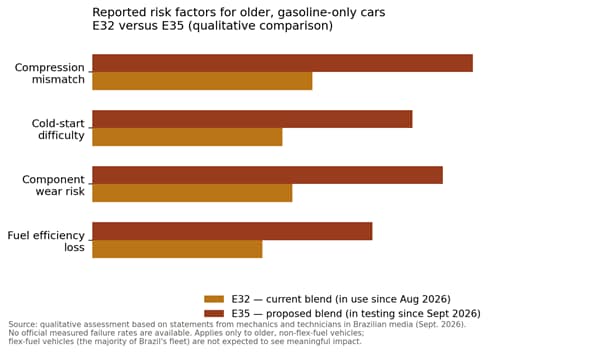
Strip away the rhetoric on both sides and the honest answer is: nobody has a completed, independent durability study on E32, let alone E35, in ordinary consumer use over time. The government points to short-term lab and road testing that found no red flags. ANFAVEA says that’s not the same as proving long-term durability. The mechanics quoted in local coverage — describing burned-out carburetor components and rough cold starts — are reporting real repair-shop observations, but on vehicles that are, by design, the minority: older, non-flex models built exclusively for gasoline, out of a national fleet that’s been majority flex-fuel for two decades.
The bottom line
This isn’t a case of a government blindsided by a problem nobody saw coming. The core objection — that Brazil keeps raising the mandatory ethanol blend faster than anyone can finish testing its long-term effects on gasoline-only engines — has been raised by the same industry group, in almost the same words, at every step since 2015. What’s different this time is that it happened alongside a federal prosecutors’ attempt to block it in court, and a minister openly conceding the calculus is as much economic as technical. Whether that amounts to negligence or a defensible trade-off between affordable fuel and mechanical risk to a shrinking slice of the vehicle fleet is, at this point, still a matter of dispute — not a settled fact in either direction.