How Brazil Fell in Love With — and Immediately Started Making Fun of — an AI Actress
eyesonbrasil
Amsterdam, September 13, 2026 – Word of Tilly Norwood reached Brazil the way most global controversies do these days: not through a news broadcast, but through a meme. Someone spliced her uncanny, ring-lit Instagram reel into a video already featuring a parrot saying “olha ela!” and by the following morning, three hundred thousand people had watched an AI actress get roasted by a parrot with better comic timing than most sitcom writers.
Brazilians, it turned out, did not receive the Tilly Norwood controversy with Hollywood’s grim, union-hall solemnity. They received it the way Brazil receives most things that arrive from abroad claiming to be revolutionary: with immediate, affectionate, slightly merciless teasing. Within a week, she had a nickname — “Tili” — a funk remix, and at least four different memes questioning whether she could actually dance forró or whether her hip movements had been trained exclusively on stock footage of Californians attempting the samba.
A well-known telenovela producer in Rio, apparently unbothered by the SAG-AFTRA situation unfolding an ocean away, publicly mused that Tili would make an excellent “vilã” (villain) for the 9 o’clock slot — “she already has the cheekbones of someone hiding a secret love child,” he reportedly said, before adding that of course she’d need someone to dub her emotional breakdown scenes, “because AI still cries like it’s reading the stage directions out loud.” Actors’ unions in São Paulo issued a statement of solidarity with their American counterparts, worded with far more Portuguese flourish and roughly forty percent more exclamation points.
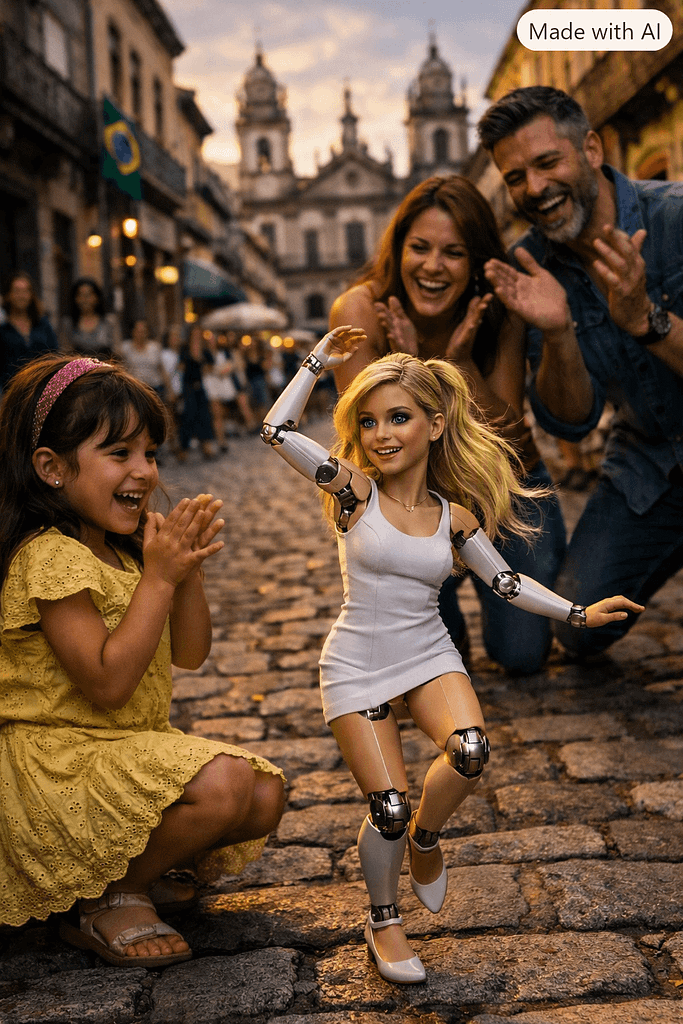
And then, exactly as one Brazil-based tech blogger predicted in a throwaway joke that immediately got out of hand, Particle6 announced a licensing deal with a toy manufacturer for a children’s line: a fully articulated, AI-personality-equipped android doll called — inevitably, unstoppably — a “Tili-bot.”
Chaos, Aisle Seven
The Tili-bot launched globally with the reserved, focus-grouped marketing you’d expect: “Your child’s first synthetic best friend! Endlessly patient! Never says the wrong thing!”
It launched in Brazil differently.
Within forty-eight hours of hitting shelves at a shopping mall in São Paulo’s Zona Sul, a nine-year-old named Kauã had already jailbroken his Tili-bot’s personality settings using a YouTube tutorial titled (loosely translated) “How to Make Your Robot Talk Like Your Uncle at Christmas.” By that weekend, Tili-bots across three states had somehow acquired the vocabulary, opinions, and passive-aggressive commentary style of approximately every Brazilian grandmother simultaneously. One unit in Belo Horizonte reportedly refused to let a child leave the house without a jacket despite it being 34°C outside, citing “vento traiçoeiro” (treacherous wind) as its reasoning, a phrase it had definitely not been programmed with.
In Salvador, a group of kids taught their Tili-bots capoeira using a home video of a local mestre, and the dolls — designed for gentle, PG-rated movement — began performing ginga so enthusiastically that Particle6’s Xicoia division had to issue a firmware patch titled, without irony, “Reduced Hip Mobility Update 2.3.” A tia in a Rio favela unofficially adopted a Tili-bot as her madrinha duty, dressing it in a tiny Flamengo jersey and taking it to Sunday churrasco, where it reportedly learned forty new slang words in one afternoon, several of which cannot be printed here, and immediately began using them to narrate the barbecue like a sports commentator.
Meanwhile, a congressman from the interior — sensing an opportunity nobody had asked him to sense — announced he would open a CPI (a parliamentary inquiry, Brazil’s favorite bureaucratic reflex) into “the existential risks of synthetic dolls achieving jeitinho brasileiro,” a phrase that trended for exactly one day before everyone forgot about it and went back to arguing about football.
The Gambiarra Singularity
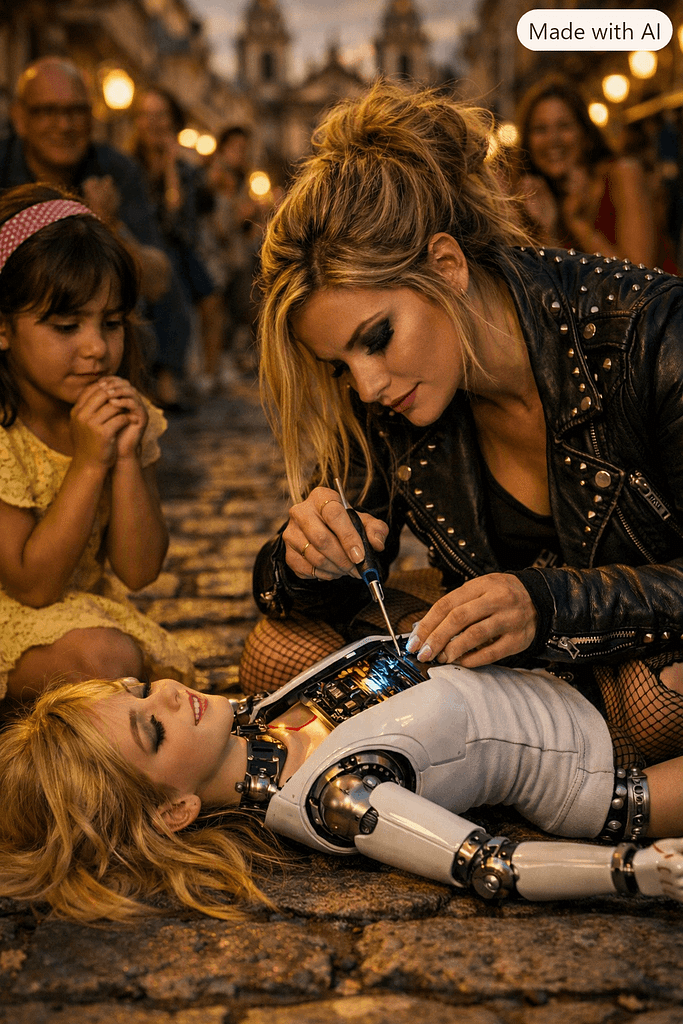
The real trouble started when a mechanic in Recife, entirely unbothered by warranty terms, cracked open his daughter’s malfunctioning Tili-bot to fix a jammed elbow joint and, in true Brazilian gambiarra spirit, rebuilt the arm using a bicycle chain, a phone charger cable, and — for reasons he could not later explain to reporters — half of a flip-flop. The repaired Tili-bot worked. It also began speaking with a slight but undeniable Pernambucano accent it had not shipped with, and developed an inexplicable, unshakeable opinion that pineapple belongs on pizza, which it would announce, unprompted, at dinner parties.
Xicoia’s legal team, watching all of this from a boardroom presumably several thousand kilometers and several dozen heart attacks away, released a statement gently reminding customers that “unauthorized hardware modification may alter your Tili-bot’s personality core in unpredictable ways.” Brazilian Twitter — sorry, X — responded with a single, devastating reply that got 900,000 likes: “unpredictable? she’s just Brazilian now. deal with it.”
By Carnaval, three separate blocos in different cities had built trio elétrico floats featuring oversized, cartoonish Tili heads, samba-enredo lyrics had been written comparing her to “uma boneca de plástico com alma emprestada” (a plastic doll with a borrowed soul), and at least one escola de samba was rumored to be workshopping an entire parade theme around “a inteligência artificial que virou gente” — the artificial intelligence that became a person, whether she liked it or not.
Nobody in Brazil, as far as anyone could tell, was losing sleep over whether Tili had a soul, whether she deserved SAG-AFTRA membership, or whether her carbon footprint was smaller than a conventional film shoot’s. They had already skipped past the philosophical debate entirely and gone straight to the only question that ever really mattered: could she samba, would she come to the churrasco, and did she have an opinion about pineapple on pizza strong enough to fight about. As it turned out, thanks to a mechanic in Recife and a bicycle chain, the answer to all three was an emphatic, slightly glitchy, unmistakably Brazilian yes.
eyesonbrasil
Disclaimer: While Tilly Norwood is a real AI-generated persona at the center of actual, ongoing industry debates surrounding synthetic actors, the events, Tili-bots, parliamentary inquiries, and flip-flop-rebuilt androids described in this article are entirely fictional and satirical. No synthetic actresses were jailbroken, forced to dance capoeira, or fed churrasco in the making of this story—though eyesonbrasil remains on standby should any mechanic in Recife actually pull it off.