



The Robots Are Milking

How Lely Is Quietly Automating Latin American Agriculture — and Brazil Is Leading the Charge
eyesonbrasil
Amsterdam, September 28, 2026 – Ten years ago, a rancher in Paraí, in Brazil’s Rio Grande do Sul, came home from a trip to Germany talking about a machine he’d seen that milked cows without a single human hand touching them. His family thought he was joking. Today, that same technology — a Dutch invention called the Lely Astronaut — has spread across more than 400 Brazilian farms, made Brazil the headquarters of Lely’s entire Latin American operation, and helped put two Paraná dairy farms at the very top of a global efficiency ranking spanning 25,000 farms and 50,000 robots worldwide.
That’s the story of Lely’s decade-long push into Latin America in miniature: slow, skeptical beginnings, followed by a rapid, still-accelerating transformation of how the region’s farmers work.
The Machine That Started It All
The Lely Astronaut, first launched commercially in the Netherlands in 1992, remains the company’s signature product: a fully automated milking robot that uses a 3D camera and laser-guided arm to locate a cow’s teats, clean and stimulate the udder, attach the milking cups, and continuously log data — milk yield, fat and protein content, temperature and conductivity — on every single milking, for every single cow, without anyone standing in the parlor.
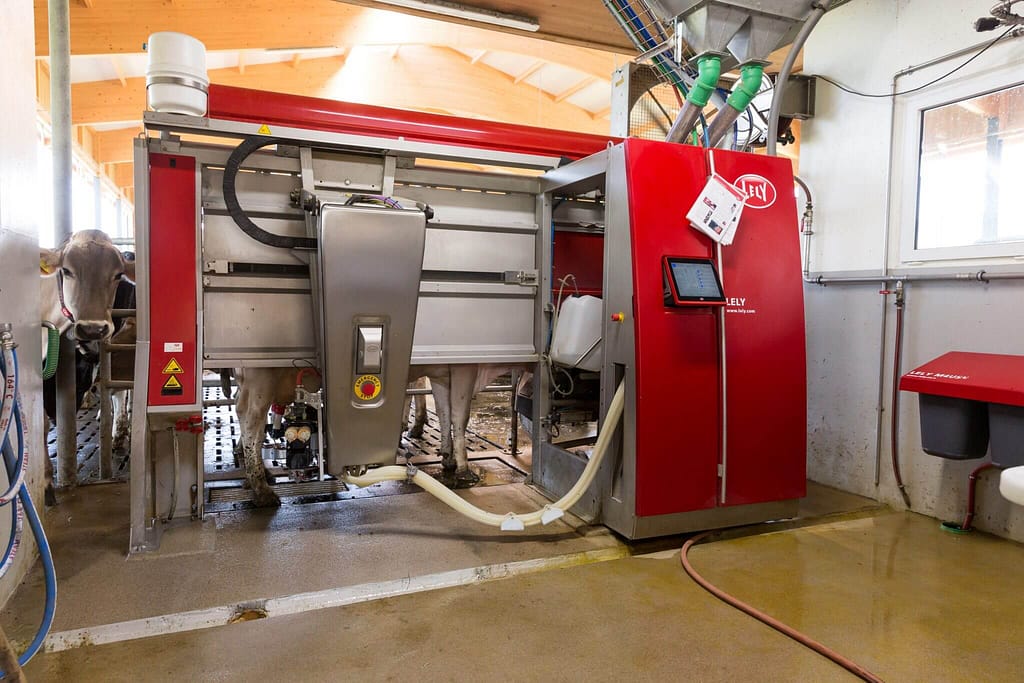
What makes the system transformative isn’t just the automation itself, but what it does to the rhythm of farm life. Under a conventional system, cows are milked on a fixed schedule set by the farmer, typically twice a day. Under the Astronaut system, cows decide for themselves when to be milked, walking to the robot at any hour, day or night, drawn by feed pellets dispensed during the process. Farmers who’ve made the switch consistently report the same things: calmer cows, fewer cases of lameness because animals no longer stand waiting in line, and — critically, in a region where finding reliable farm labor has become steadily harder — dramatically less dependence on hired hands.
Beyond the Milking Robot: A Full Toolkit
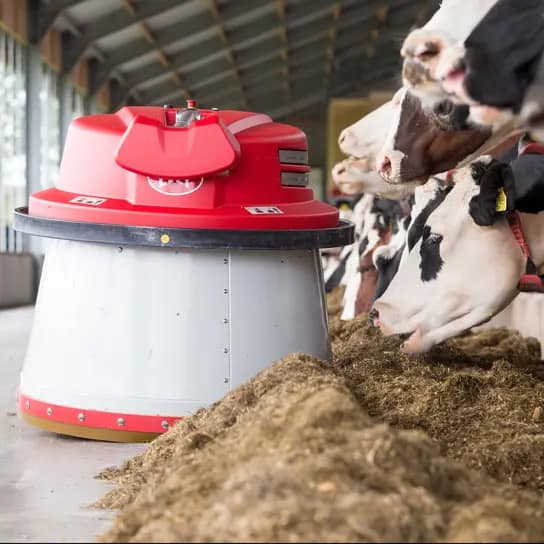
Lely’s expansion in Latin America hasn’t stopped at the milking robot. The company has been steadily introducing the rest of its automation lineup, each targeting a different piece of the daily grind on a dairy farm:
- Lely Juno, an autonomous feed-pushing robot that trundles along the feed fence at set intervals, nudging silage back within reach of cattle so they don’t have to strain or wait for a human with a tractor to do it.
- Lely Discovery Collector, a robotic manure vacuum that keeps barn floors clean automatically, reducing hoof disease and improving hygiene without manual scraping.
- Lely Vector, an automated feeding system that mixes and delivers fresh rations around the clock based on each group of cows’ actual needs, rather than a single large feeding once or twice a day.
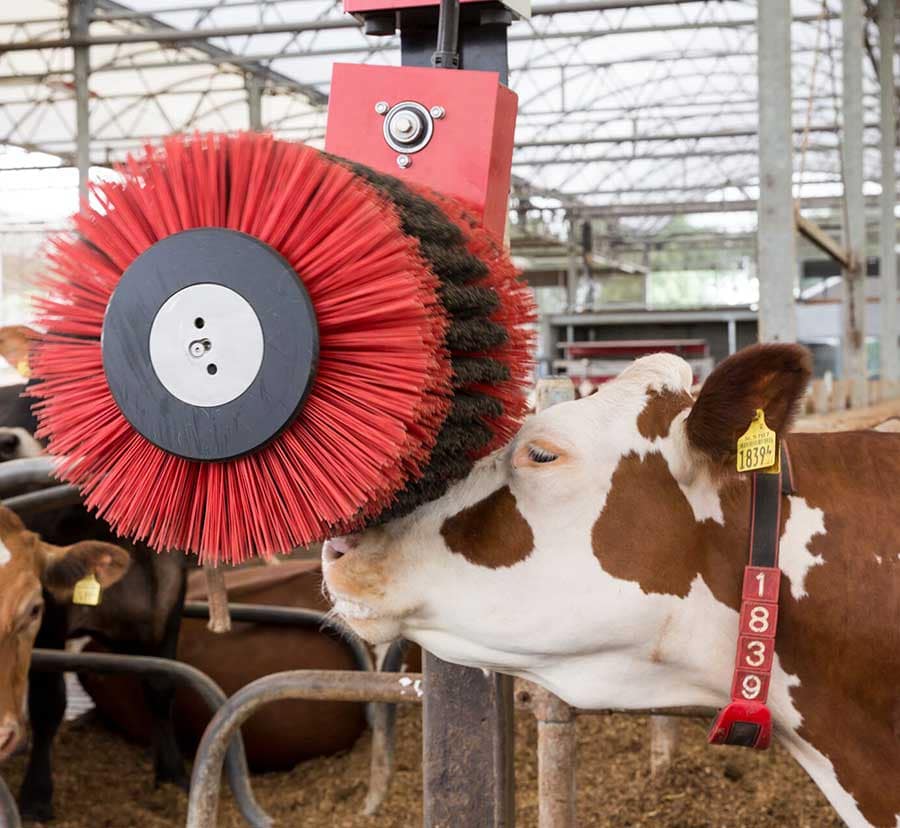
- Lely Luna, a rotating cow brush that lets animals groom themselves on demand, which sounds trivial until you learn it measurably reduces stress and improves circulation and coat health.
Behind all of it sits Lely’s Horizon management software, which pulls data from every robot on a farm into a single dashboard — turning what used to be a farmer’s intuition and daily walk-through into a continuously updated stream of decision-ready information. As one Lely executive overseeing the South American market put it, the real product isn’t the hardware; it’s the algorithm sitting behind the platform that converts raw robot data into decisions a farmer can act on.
Why Brazil Pulled Ahead
Lely entered Latin America in 2013, opening its first regional office in the Brazilian state of Paraná — a region with a strong historical footprint of Dutch immigration and, not coincidentally, one of Brazil’s most developed dairy belts. The first Astronaut robot in the country went into operation the following year in Castro, Paraná.
More than a decade later, the numbers confirm the country’s centrality to the whole regional project. Brazil now has more than 400 Lely milking robots installed, concentrated overwhelmingly in family-run operations with one or two machines apiece, each robot typically serving around 60 cows. In September 2019, Lely marked the milestone by inaugurating a dedicated Latin American headquarters in Carambeí, Paraná — a facility built with roughly R$10 million in investment that centralizes operations across Brazil, Argentina, Chile and Uruguay, and even supplies equipment onward to Lely’s newer market in Mexico. Company executives have described the next decade as one of consolidating growth specifically around Brazil and the wider South American market, with eventual plans to explore local assembly of the machines rather than importing every unit from the Netherlands.
The clearest evidence of Brazil’s leadership, though, may be qualitative rather than just quantitative: in Lely’s 2025 global efficiency ranking — compiled across more than 25,000 farms and 50,000 robots operating worldwide — the top two spots for average daily milk production per cow both went to farms in Paraná, led by Fazenda Melkstad at 54.5 kilograms of milk per cow per day. For a country whose dairy sector has often been characterized as fragmented and technologically behind more industrialized producers, that result is a striking reversal.
Argentina’s Different Path: Fewer Farms, Bigger Bets
If Brazil represents breadth — hundreds of small, family-scale installations — Argentina represents a different adoption pattern: fewer farms, but often outfitted with multiple robots at once. Lely’s first Argentine installation came in 2018 at “El Rancho,” a pasture-based operation in Tandil run by the Baudrix family, which started with six robots and added two more within a few years. By the end of 2022, Lely alone had 129 robots running across 23 Argentine dairy farms — nearly half of the entire national market for automated milking systems, which across all brands (Lely, DeLaval, GEA and others) totaled 267 robots sold and roughly 125 installed and running across 56 farms. Industry watchers projected the countrywide total, across all manufacturers, would approach 300 robots by the end of 2023, concentrated heavily in Buenos Aires, Córdoba and Santa Fe provinces — Argentina’s traditional dairy heartland.

The contrast tells its own story about the two markets: Brazilian adoption has spread wide and shallow, reaching many small producers one or two robots at a time, while Argentine adoption has gone narrower and deeper, with larger, more capital-intensive operations betting on multi-robot barns from the outset.
Uruguay and Chile: The Smaller, Steady Partners
Rounding out Lely’s four-country Latin American footprint are Uruguay and Chile, both smaller markets but active ones. Uruguay’s Lely Center Cariplal runs four Astronaut robots on a farm that transitioned from a conventional parlor, reporting improved udder health and a surprisingly fast adjustment period as cows learned the new routine. Across the four-country region, Lely now operates through a network of twelve dedicated Lely Centers, providing the sales, installation and round-the-clock technical support that automated dairy farming depends on — since a milking robot that breaks down at 2 a.m. with no technician on call isn’t an efficiency gain, it’s a crisis.
The Bigger Transformation
What’s happening on these farms adds up to more than a hardware upgrade. Robotic milking is reshaping the underlying economics and demographics of Latin American dairy farming: it reduces dependence on increasingly scarce and expensive farm labor, it generates a volume of animal-health and productivity data that simply didn’t exist under manual systems, and — perhaps most significantly for a region long associated with commodity-scale, lower-margin agriculture — it’s starting to produce genuine global leaders in dairy efficiency rather than followers.
Brazil’s emergence as both Lely’s largest Latin American market and the current holder of the company’s top global efficiency rankings suggests the transformation has moved past the experimental phase. The technology that a skeptical Brazilian rancher’s family once laughed off a decade ago is now, by the company’s own numbers, out-producing dairy operations in far more traditionally advanced markets — a reminder that automation’s biggest gains sometimes show up furthest from where the technology was invented.