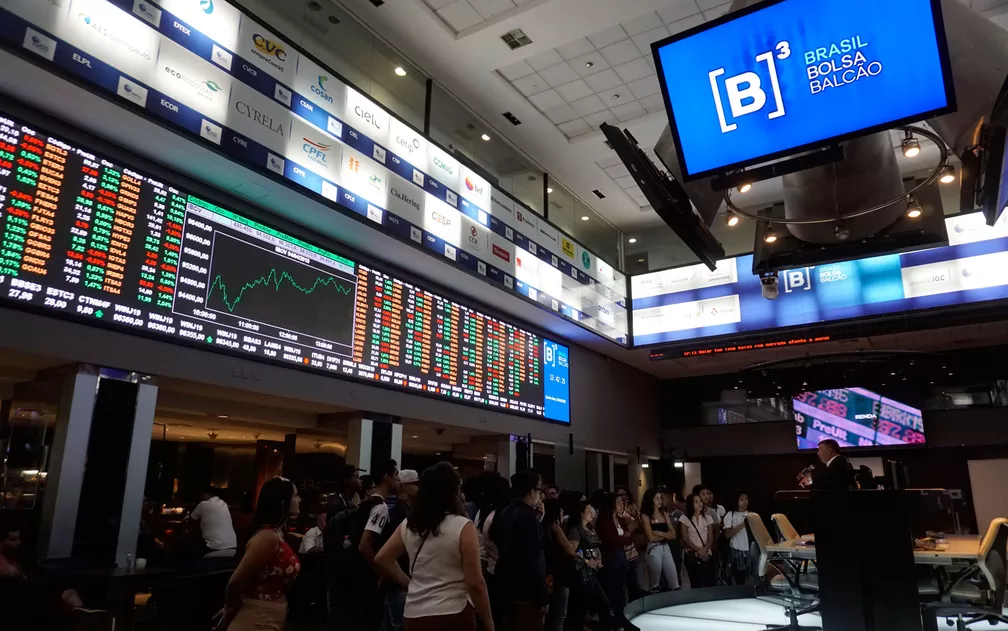
Two shocks in three weeks. The first was a halt in trading. The second was a verdict from Wall Street.
eyesonbrasil
On the morning of October 26, São Paulo’s exchange did something it had not done since the pandemic: it stopped the market. The B3 triggered its circuit breaker after the Ibovespa fell 10% from the prior close, in the first session after Lula’s reelection. Trading in the cash market was suspended for 30 minutes. The mechanism has a long and unflattering history: it fired in 2008 during the Lehman collapse, and in 2017 when the JBS plea deal nearly toppled President Temer. Brazil’s circuit breaker tends to appear when investors stop pricing a country as a business and start pricing it as a risk. By the close, the index had fallen 13.88%, its worst day since March 2020.
Then came the sequel. On November 16, Morgan Stanley moved Brazil from equal-weight to underweight, the equivalent of a sell, in its Latin America strategy. It now sees the Ibovespa at 160,000 points at the end of 2027, 7.2% below the prior Friday’s close. The bank is not bearish on the region. It kept a positive stance on Latin America as a whole, and its strategists see the region still benefiting from the global AI investment cycle. That makes the verdict harsher. Brazil is being singled out. Its neighbors are in the same tide, and Brazil is the one being marked down.
Seen from a trading floor in Manhattan, the reasons are not mysterious. They are old, and they keep returning.
1. No fiscal anchor
The most damning line in Morgan Stanley’s reasoning is not about sentiment. It is about arithmetic. The bank cited the absence of a fiscal rule that would change the trajectory of public debt. Global investors can live with a high-debt emerging market if there is a credible rule that bends the curve. What they will not underwrite is open-ended spending with no binding constraint. In New York, the missing anchor is the central question, and everything else is commentary.
2. Interest rates that crowd out the stock market
Brazil’s high interest rates are a standing problem for equities. The bank’s report highlights “crowding out” and lists elevated rates among its reasons for caution. When the risk-free rate at home is that rich, a pension fund in Connecticut has little reason to hold a volatile equity index. High rates also raise financing costs for the companies that make up the index. So the stock market is squeezed from both sides: it competes with government paper for capital, and its earnings are taxed by the price of debt.
3. Earnings at risk
The downgrade is not only a macro story. Morgan Stanley sees a risk of Brazilian corporate earnings falling 10% to 20%. It expects the index’s price-to-earnings multiple to compress to 7.8 from 8.7 by the end of 2027. Brazilian equities are already cheap by global standards, and the bank says they should get cheaper. That is the clearest expression of a trust discount: a market that deserves a lower price for the same profits.
4. Structural bottlenecks that never quite get fixed
The Brazilian press summarized the bank’s case as high rates, risks to corporate profits and structural obstacles in the economy. Foreign investors have heard “structural reform” promised for decades. Tax complexity, a heavy state footprint, and low productivity growth are familiar problems. Each cycle brings a new reform narrative, and each cycle the same constraints return. Credibility is a depreciating asset. After enough unfulfilled promises, investors stop paying for the promise.
5. Policy unpredictability, and a government that dismisses the market
The October 26 sell-off was a referendum on direction, as much as on any single policy. Investors were not shocked that a candidate won. They were rattled by what they expect from the next four years: more spending, no fiscal rule, and little appetite for market-friendly reform. Lula’s response to the sell-off did little to calm nerves: he declared that the market would not teach him how to govern. Governing is not the market’s job, and investors know that. But capital is not obliged to stay, and it votes with its feet. The currency, which weakened to about 5.78 reais per dollar on the day of the downgrade, is where that vote shows up first.
6. A pattern, not an accident
A market that triggers circuit breakers in 2008, 2017, and 2026 is telling you something about its political and fiscal shock-absorbers. The mechanism had been triggered 23 times before this year’s event, which made it the 24th. Individually, each episode has an explanation. Together, they describe a market that foreign investors treat as fragile at the edges.
The case for the defense
Brazil’s defenders have a real argument. Valuations are already low, which means bad news is partly priced in. The country has deep capital markets, a diversified economy, and real exporters that can thrive regardless of domestic politics. Morgan Stanley itself is selective: its preferred picks include Suzano, Embraer and JBS, which earn much of their revenue abroad. And an underweight call is a relative judgment, not a prediction of collapse. If a credible fiscal framework emerges, today’s skeptics could become tomorrow’s buyers.
The bottom line
Trust in a stock market is not built on slogans or on the strength of a single quarter. It is built on rules that hold, numbers that add up, and governments that make their commitments binding. From New York, Brazil’s discount is not a conspiracy against São Paulo. It is the price of a missing fiscal anchor, expensive money, uncertain earnings and a long record of promises that went unmet. The way to win back the room is not to argue with it. It is to give it something to believe in.
Sources: Brazilian and international financial press reports on the Morgan Stanley Latin America strategy note (as carried by InfoMoney, Times Brasil, Suno, The Private Banker and others) and on the October 26, 2026 trading halt (Suno, Folha Max, InvesTalk). Some outlets reported conflicting intraday figures that day; only the closing figure and facts on which the reports agree are used here.