


A U.S. Startup Is Betting Big on Brazilian Rock

But Brazil’s Carbon Market Rules Are Still Being Written
eyesonbrasil
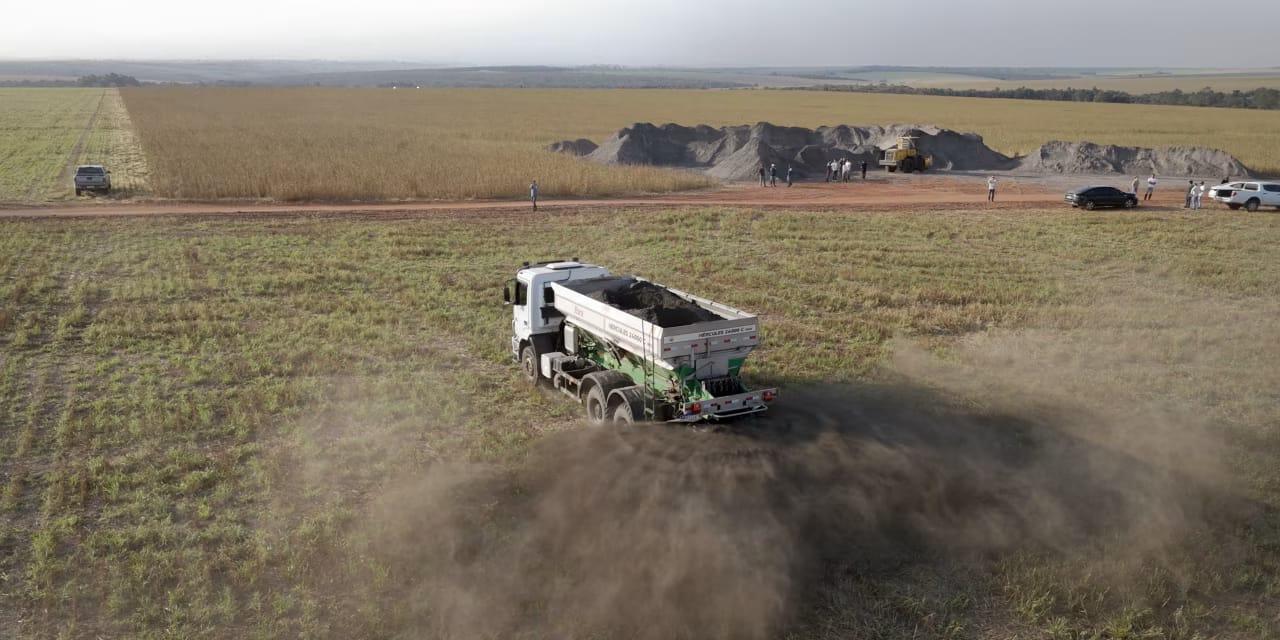
Amsterdam, August 9, 2026 – Deep in the farm country of São Paulo and Paraná states, trucks have been spreading a fine, dark powder across thousands of hectares of cropland. It looks like nothing special — crushed volcanic rock, the kind you might find at a quarry. But for Terradot, a San Francisco-based carbon removal company with a major operational base in Brazil, that basalt dust is the foundation of a bet that Brazil can become one of the world’s most important carbon removal hubs.
The Company: Turning Farmland Into a Carbon Sink
Terradot uses a method called Enhanced Rock Weathering (ERW), which leverages natural geological processes to capture and sequester CO2 by spreading finely crushed rock over farmland, where chemical reactions with soil and water bind CO2 into stable mineral forms. In plain terms: when rain hits the crushed basalt, it triggers a chemical reaction that pulls carbon dioxide out of the atmosphere and locks it away — permanently — as dissolved bicarbonate that eventually washes to the ocean, where it’s stored for thousands of years. Terradot sources basalt from quarries across southern Brazil, transports it to nearby farms where it is spread on farmland to absorb CO2, then measures how much CO2 has actually been removed.
The company didn’t pick Brazil by accident. The country’s warm, humid climate and well-drained clay and sandy soils create optimal conditions for accelerated rock weathering — and Brazil offers a tropical climate that naturally speeds up weathering rates, strong agricultural infrastructure, quarries located close to farmland, and a predominantly clean power grid that keeps operations low-carbon.
The growth numbers are striking. Since launching operations, Terradot has expanded its Brazilian footprint to cover basalt spread across 5,000 hectares of farmland — an area roughly the size of Manhattan — and expects to deliver its first verified carbon removal credits by the end of 2025. The company isn’t slowing down: it plans to expand deployment fivefold by the end of 2026, targeting 600,000 tonnes of rock applied across 25,000 hectares. Its Brazilian operations now span six states, supported by a team of more than 75 professionals, with roughly two-thirds based in São Paulo state.
Big money and big buyers have taken notice. Terradot has secured backing from major investors including Google, Microsoft’s Climate Innovation Fund, and John Doerr, and signed carbon removal agreements including Google’s largest single purchase of carbon removal, totaling 200,000 tonnes. Separately, buyers organized through the nonprofit Frontier agreed to pay $27 million to remove 90,000 tons of CO2 between 2025 and 2029. Microsoft has gone further still, partnering directly with Terradot on a field validation project in Brazil to test the durability of the carbon removal claims.
Why This Matters — And Why It’s Still Risky
Here’s the catch: Terradot, Mombak, InPlanet, re.green, and the other companies racing to sell Brazilian carbon credits are all operating almost entirely in the voluntary carbon market — private deals between companies like Microsoft or Google and project developers. Brazil’s long-promised regulated national carbon market, meant to create a mandatory, government-backed system, is still, in large part, a work in progress.
Why the Regulated Market Is Still Stalled
Brazil took a genuinely historic step in December 2024. On October 16, 2025, President Lula signed a decree creating the Extraordinary Secretariat for the Carbon Market within the Ministry of Finance, tasked with building out the regulatory and institutional framework for Brazil’s forthcoming emissions trading system — the SBCE. Published in December 2024, the Carbon Market Law establishes the SBCE as Brazil’s national emissions trading system, covering entities that emit more than 25,000 tCO2e per year, with reporting obligations beginning at 10,000 tCO2e.
But passing a law and running a functioning market are two very different things. The SBCE is designed to roll out over a six-year implementation period across five phases: an initial phase (originally set to run until December 2025, extendable by another 12 months) for issuing further regulations; a second phase running until December 2026 in which companies must operationalize their emissions-reporting tools; a two-year third phase in which operators only need to submit monitoring plans; and only in the fourth phase, starting in December 2028 at the earliest, does actual quota trading begin.
In other words, real cap-and-trade activity — companies actually buying and selling government-issued emissions allowances — isn’t expected to start for at least another two years, and possibly longer if any phase gets extended.
Several concrete gaps explain the delay:
- No managing body yet. Since there is still no regulation on which methodologies will be accepted within the SBCE, project developers must design projects around internationally recognized standards instead — standards that will likely be adopted or serve as a framework once the SBCE’s own methodologies are finalized. Brazil’s carbon market is still undergoing consolidation, with the law itself only laying the groundwork for regulation, while full implementation could take years. The law’s own governance body — the entity that would actually run day-to-day operations, set rules, and enforce penalties — has not yet been fully stood up.
- Sector coverage is still being decided. As of May 2026, the Ministry of Finance had only released a preliminary proposal — not yet legally binding — to determine which sectors of the economy will fall under the regulated market, pending review by an advisory committee and a public consultation scheduled for later in 2026. Companies don’t yet know for certain whether they’ll be covered, making long-term investment planning difficult.
- International recognition is incomplete. This matters beyond Brazil’s borders. As of April 2026, the SBCE was not yet fully operational, and the EU Commission had not completed its formal assessment of whether the system meets the qualification criteria under Article 9 of the EU’s Carbon Border Adjustment Mechanism (CBAM) — the rule that determines whether Brazilian exporters can get credit for domestic carbon pricing when selling into Europe. Until that assessment is done, Brazilian steel and fertilizer exporters remain exposed to the full cost of EU carbon tariffs.
- The voluntary market itself has credibility scars. Regulatory uncertainty isn’t the only headwind. Verra, one of the most widely used carbon credit certifiers operating in Brazil, has faced its own credibility issues — in 2023 an investigation cast doubt on the legitimacy of roughly 90% of its credits, and in 2025 Verra suspended three Brazilian projects following a police investigation into ties with land-grabbing and illegal logging. That kind of scandal makes both buyers and regulators more cautious about how any future compliance market recognizes voluntary-market credits.
- A parallel exchange is only just getting started. The national stock exchange B3 has partnered with AirCarbon Exchange to build a trading platform for carbon credits, launched as a pilot at New York Climate Week 2025 — but as of April 2026 it only supports credits from a single reforestation methodology, developed by two specific companies. It’s a proof of concept, not yet a liquid, functioning market.
The Bottom Line
Companies like Terradot are moving fast precisely because they don’t have to wait for Brazil’s compliance market to mature — they’re selling directly to corporate buyers like Google and Microsoft on the voluntary market, where deals close in months, not years. But that speed is also the market’s weak point: without a fully operational SBCE, consistent measurement standards, a functioning trading exchange, and international recognition under mechanisms like CBAM, Brazil’s carbon economy remains a patchwork of private contracts rather than a unified, government-backed system. Until the SBCE’s managing body is established, sector coverage finalized, and the phased rollout actually reaches the trading stage — not expected before 2028 at the earliest — the “market” that headline-grabbing deals refer to is really a collection of bilateral bets that Brazil’s regulatory promise will eventually catch up with its ecological potential.