


The Girl Who Turned Orange Peels Into Water
eyesonbrasil
In 2016, South Africa was running dry. A severe drought, among the worst in decades and worsened by El Niño, had cracked open farmland across the country. Crops failed, livestock died, and farmers watched the sky for rain that didn’t come. Commercial soil-moisture products existed, but they were expensive, made from petroleum-based chemicals, and out of reach for many of the people who needed them most.
Kiara Nirghin, a sixteen-year-old from Johannesburg, looked at the problem and asked a simple question: what if the answer was something people were already throwing away?
An idea from the rubbish bin
Kiara’s attention turned to orange peels. Every day, juice factories and households discard enormous quantities of them. They are rich in pectin, a natural substance that can bind and hold water.
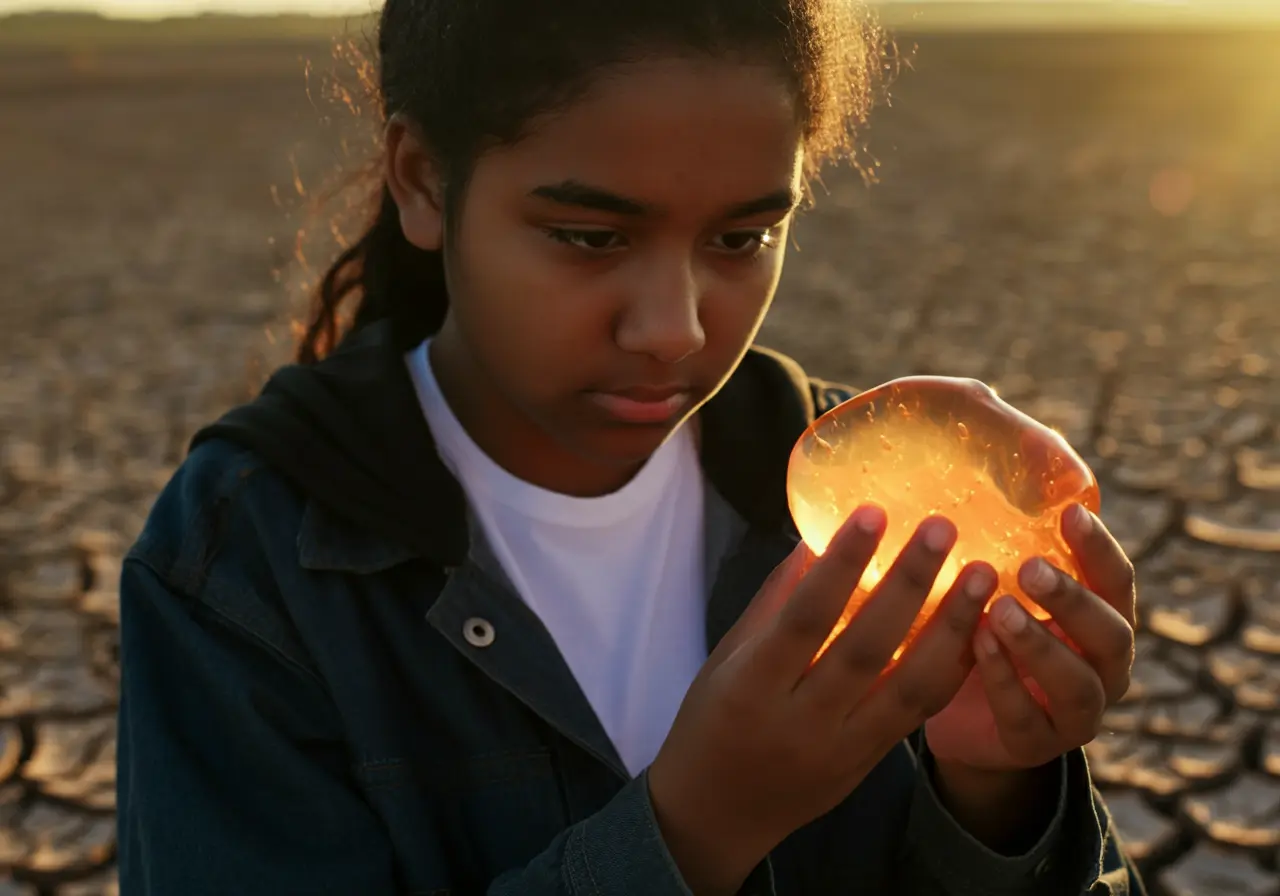
Her project, called No More Thirsty Crops, turned that waste into a superabsorbent polymer. Dried and processed, the peels form a material that acts like a tiny reservoir in the soil, soaking up water when it’s available and releasing it slowly to plant roots. As the story is usually told, one application could help soil stay moist for around twenty days. She also reportedly added avocado skins to the mix to improve the material’s performance.
Why it mattered
The conventional alternatives are synthetic superabsorbent polymers derived from oil. They work, but they come with two big drawbacks.
Cost. In the figures Kiara’s project cited, the peel-based product could be made for roughly $30 per ton, against about $3,000 per ton for the chemical version. That is a hundredfold difference, and for a small farmer it is the difference between a product that exists on paper and one that can actually be bought.
Environmental impact. Oil-based polymers do not break down naturally and can linger in the soil for a very long time. Kiara’s material is organic, so it decomposes on its own and leaves nothing behind.
The inputs were modest as well. Orange peels cost almost nothing, and the main requirement for manufacturing was electricity. This was a technology meant to travel to rural farms rather than stay in a laboratory.
From a school project to the world stage
Kiara entered her idea in the Google Science Fair, one of the world’s best-known competitions for young innovators. She won the Community Impact Award for her age category, and with it recognition far beyond South Africa. Her story spread around the globe, and she became one of the most visible young faces of sustainable innovation on the African continent.
What makes her story resonate is not only the science but the way of thinking behind it. She didn’t need a vast laboratory or a venture-capital round. She needed curiosity, a clear understanding of a real human problem, and the willingness to see value in what everyone else considered garbage.
A lesson bigger than oranges
As climate change makes droughts more frequent and severe, solutions like Kiara’s point toward a different way to build technology: local, cheap, biodegradable, and designed around the people who face the problem. Agricultural waste is abundant almost everywhere, and the idea of turning it into a tool for resilience is powerful.
A fair caveat: the headline numbers, including the twenty-day moisture retention and the cost comparison, come from her competition project and the media coverage around it. They are encouraging, but a prize-winning prototype is not the same as a proven commercial product, and large-scale field testing would be needed to confirm them. That doesn’t diminish what she achieved. It shows how far a good idea can travel when a young person is given the stage to present it.
Kiara Nirghin showed that innovation doesn’t always start with something new. Sometimes it starts with looking differently at what we already have, even if that is only the peel of an orange.