


Brazil’s high-stakes bet: can the Amazon stay under 0.5%?

eyesonbrasil
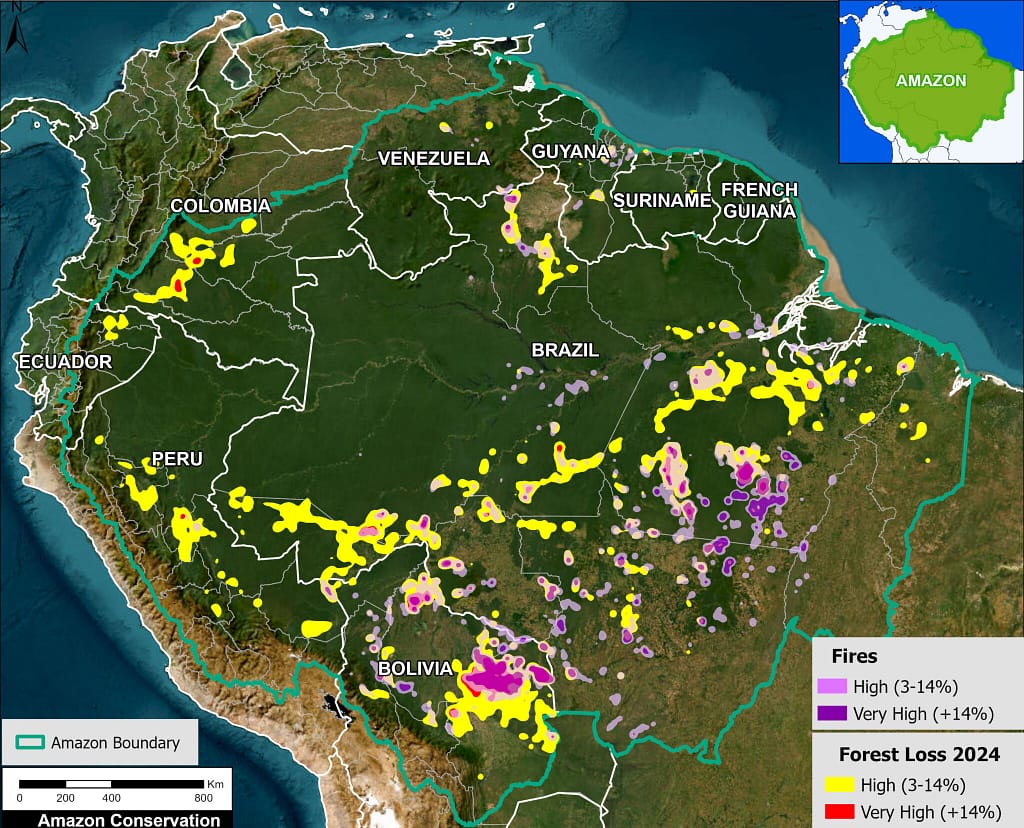
Amsterdam, August 13, 2026 – Look closely at a satellite map of the Amazon and a pattern jumps out immediately: the forest isn’t eroding randomly. It’s eroding along an edge — a scorched, fragmented arc that traces the southern and eastern rim of the basin, spilling from Brazil into Bolivia, Peru, and Colombia. Deforestation hotspot maps compiled from 2020 satellite data show exactly this: a curtain of red and yellow clusters running through Rondônia, southern Amazonas, Pará, and Mato Grosso, with a smaller but intense cluster near Colombia’s border. Ecologists have a name for it — the “arc of deforestation” — and it sits at the center of one of the more interesting contradictions in Brazil’s climate strategy right now.

Because at the very same time this arc keeps burning, Brazil is asking the world to bet $125 billion on the idea that its forests will stay standing.
A fund with a hard line in the sand
The Tropical Forests Forever Facility (TFFF), the centerpiece initiative Brazil championed at COP30, is elegantly simple in concept: pay tropical forest countries roughly $4 for every hectare of intact forest they maintain, funded not by donor grants but by returns generated from a blended investment fund. It’s designed to finally put a price on the thing the world has always undervalued — a forest that simply keeps existing.
But the fund isn’t a blank check. To qualify, a country’s annual deforestation rate has to stay below 0.5%. And the penalties for crossing that line are steep by design: every hectare deforested in a given year triggers a deduction equivalent to 100 standing hectares’ worth of payment if the national rate is under 0.3%, and 200 hectares’ worth if it’s between 0.3% and 0.5%. Degraded hectares — forest damaged by fire, logging, or fragmentation without being fully cleared — carry their own separate penalty. The ceiling doesn’t stay put, either: the threshold is set to tighten progressively, down to 0.2% within fifteen years.
That’s the fine print behind the applause Brazil received at COP30. And it’s exactly why the map matters.
The gap between the headline number and the whole picture
On paper, Brazil is in decent shape. Official PRODES satellite data from Brazil’s national space institute showed Legal Amazon deforestation falling to roughly 5,800 square kilometers in the twelve months through mid-2025 — an 11% year-on-year drop, the lowest tally in over a decade, and part of a trend that has cut deforestation by roughly half since 2022. Measured against the Legal Amazon’s roughly 400 million hectares, that puts Brazil’s raw clearing rate comfortably under the TFFF’s 0.5% ceiling — nowhere close to disqualifying.
So where’s the dilemma?
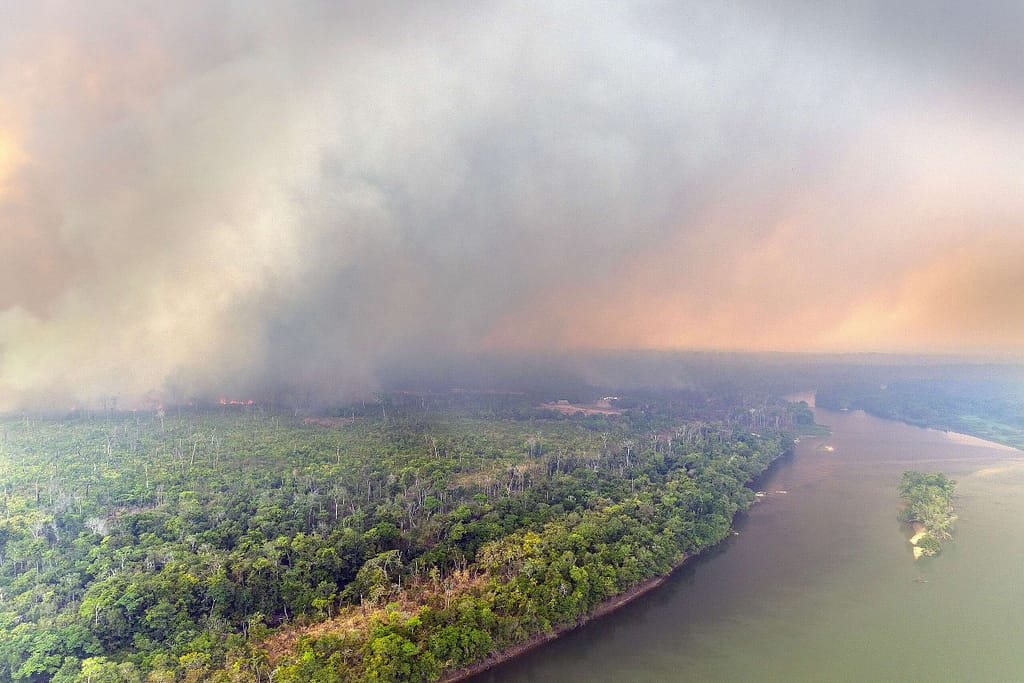
It’s in what PRODES doesn’t fully capture. Brazil’s own calculations, based on 2023 data, put the country’s rainforest deforestation rate at 0.28% — safely below the threshold — but its fire-degradation rate at 0.47%, right up against the ceiling. Degradation is the quieter, harder-to-police cousin of deforestation: a patch of forest that’s been logged, fragmented by roads, or scorched by an escaped agricultural fire doesn’t always register as “cleared,” but it becomes tinder-dry and far more likely to burn again the following year. The hotspot clusters visible along that southern arc are, in large part, exactly this kind of frontier — land that’s been nibbled at by roads, cattle ranching, and soy expansion long before a chainsaw ever fully clears it.
That distinction is not academic under the TFFF’s rules. Because degradation carries its own deduction, and because the eligibility threshold itself is scheduled to ratchet down over time, Brazil doesn’t just need to hold its current trajectory — it needs the arc of deforestation to keep shrinking, year after year, while global demand for land, soy, and beef keeps pushing outward against it.
Two markets, one forest, opposite incentives
Here’s what makes this genuinely a dilemma rather than just a policy footnote: Brazil is simultaneously the country with the most to gain from a thriving voluntary carbon market — where standing forest, REDD+ projects, and restoration credits are worth real money to foreign buyers — and the country whose economy runs substantially on the same land under pressure from cattle, soy, and mining interests. Every hotspot glowing red on that map represents, in effect, a small bet against Brazil’s own TFFF eligibility and against the credibility of the carbon credits it’s trying to sell into the voluntary market at a premium.
The two systems reinforce different behaviors, too. The voluntary carbon market rewards specific, well-verified conservation projects — a reforestation initiative here, a REDD+ concession there. The TFFF operates at the level of the entire country, meaning Brazil’s national average has to hold the line even as regional hotspots in Pará, Rondônia, or Mato Grosso do exactly the opposite. A handful of well-managed offset projects can look successful in isolation while the aggregate national picture still drifts toward the ceiling.
The narrowing path ahead
None of this means Brazil’s climate ambitions are hollow — the deforestation trend is real, the enforcement gains under the current administration are measurable, and the country remains, by a wide margin, the most consequential single actor in the entire tropical forest finance conversation. But the margin for error is thinner than the headline numbers suggest. A rate hovering in the high 0.2s or low 0.3s, next to a degradation rate brushing 0.5%, and a threshold set to tighten to 0.2% within fifteen years, leaves very little room for the arc of deforestation to have a bad year.
Brazil’s dilemma, in the end, isn’t a contradiction between ambition and reality — it’s a race between them. The country has built the architecture, made the pledges, and put a price on its forests that the world seems ready to pay. Whether the hotspots on that satellite map keep shrinking fast enough to collect on it is a separate question entirely, and one that satellites, not speeches, will ultimately answer.
This article is for general informational purposes and does not constitute investment, legal, or policy advice.