


After the moratorium

Can a Swiss farmer’s forest logic save the Amazon’s edge?
eyesonbrasil
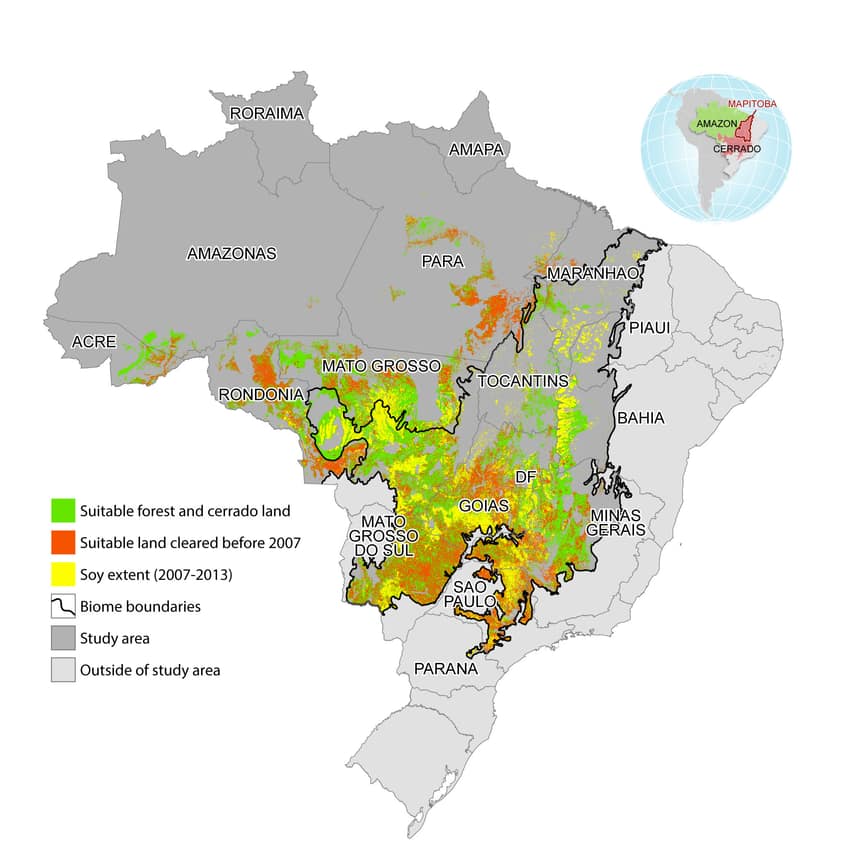
Amsterdam, August 14, 2026 – For nearly twenty years, one quiet agreement did more to slow Amazon deforestation than almost any law on the books. Signed in 2006 by the world’s biggest grain traders — Cargill, Bunge, Cofco, Louis Dreyfus — the Amazon Soy Moratorium simply said: we won’t buy soy grown on Amazon land cleared after 2008. It wasn’t glamorous. It wasn’t even legally binding. But it worked, decoupling one of Brazil’s biggest export industries from one of the world’s most consequential forests.
This year, it effectively died.
In January 2026, the Brazilian Association of Vegetable Oil Industries — representing traders who together handle over half of Brazil’s soy exports — formally withdrew from the pact. The trigger wasn’t environmental backlash; it was money. Mato Grosso, Brazil’s largest soy-producing state, passed a law stripping tax breaks from any company that kept honoring the moratorium’s restrictions. Companies that stayed in the agreement would simply pay more tax than those that left. Predictably, nearly all of them left. This week, Brazil’s Supreme Court delivered the final word: it upheld the state tax laws that killed the pact’s economics, while — almost as an aside — affirming that the moratorium itself had been perfectly constitutional all along. Abiove, the industry group, called it the end of legal uncertainty. Greenpeace Brazil called it a contradiction: the court recognized the moratorium’s environmental value while validating the exact mechanism used to gut it.
Researchers estimate the fallout at up to 1.4 million hectares of additional deforestation over the next decade — an area roughly the size of Portugal, releasing carbon emissions comparable to Canada’s entire annual output. Indigenous leaders across the Amazon are already reporting rising anxiety about invasions near their territories, with satellite imagery showing forest loss creeping toward at least one protected area.
Into this vacuum steps an unlikely figure: a 77-year-old Swiss farmer who has spent four decades arguing that agriculture and forest were never supposed to be enemies in the first place.
The man who farms like a forest
Ernst Götsch moved to Bahia, Brazil, in the early 1980s after walking away from a genetics research post in Switzerland. What he found on arrival was a patch of land the local farming community considered a lost cause — pasture so degraded that nobody expected it to produce anything again. Four decades later, that same land, Fazenda Olhos D’Água, is a working forest. It grows cocoa, fruit, and timber commercially, while hosting biodiversity levels that researchers have found comparable to untouched rainforest.
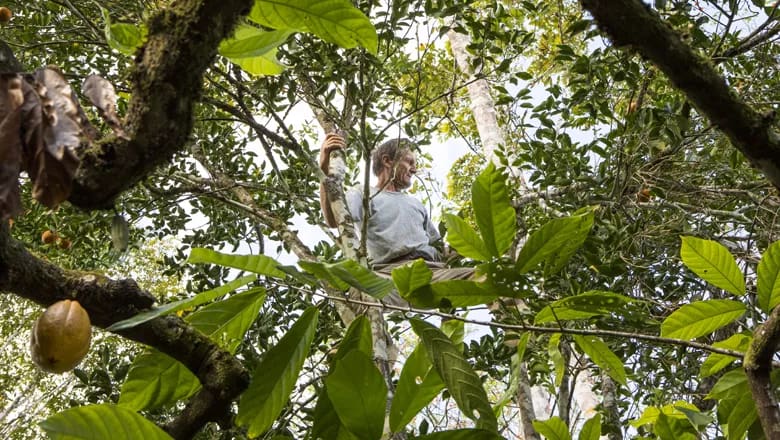
Götsch calls his method syntropic farming, and the core idea inverts almost everything conventional agriculture assumes. Instead of clearing land and holding it artificially in a simplified, low-diversity state — which is what monoculture, including soy, fundamentally does — syntropic systems work with ecological succession. They plant dense, layered combinations of species timed to mimic how a forest naturally rebuilds itself after disturbance, using the plants’ own biomass instead of external fertilizer, and relying on root systems and canopy structure to rebuild soil and regulate local water cycles. Trees aren’t decoration around the crop; they’re doing the actual agricultural work.
By Götsch’s own accounting, the economics aren’t just ecologically nice — they’re competitive. He estimates that forestry-based systems can be roughly eight times more profitable than grain monoculture over the long run, once revenue from timber, fruit, and cocoa is counted alongside the avoided cost of pesticides and fertilizer. That’s not a modest efficiency gain. That’s a different business model entirely.

Why this isn’t a simple swap-in for soy
It would be satisfying to say syntropic farming can simply replace the acreage the Soy Moratorium used to protect. It can’t, and being honest about why matters more than the pitch.
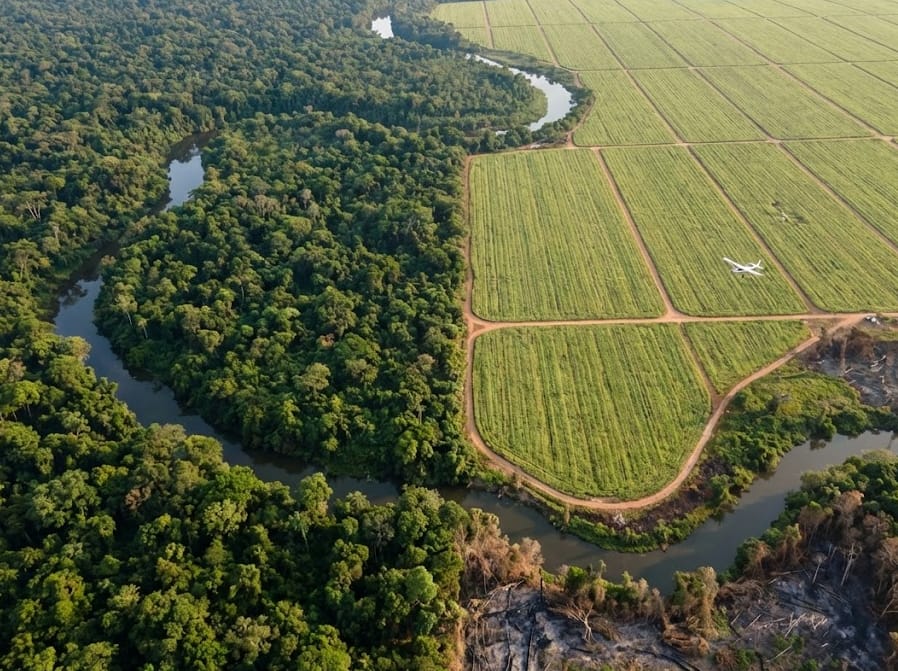
Soy’s entire commercial logic depends on being interchangeable. A shipload of Brazilian soybeans headed to a Chinese port — which absorbs 43% of Brazil’s soy exports — doesn’t need character or diversity. It needs to be exactly like every other shipload, harvested by machines moving across thousands of contiguous hectares, priced against a global commodity benchmark. Syntropic systems produce almost the opposite: staggered, diverse harvests of fruit, timber, and grain that don’t move through the same ports, buyers, or financing structures. The value is real, but it doesn’t slot into the infrastructure soy built.
Scale is the second wall. Researchers at Brazil’s Center for Research in Syntropic Farming have been running field trials since 2018 specifically to find spacing and species combinations that would let syntropic grain cultivation be mechanized at scale — and they’re doing it largely by hand and microtractor, because the specialized machinery Götsch has designed for this purpose doesn’t fully exist yet. It’s promising, active research. It is not, today, a technology a Mato Grosso soy operation could adopt next planting season.
And then there’s time. Syntropic restoration is a multi-year investment before it produces meaningful income, let alone Götsch’s eightfold return. Much of the pressure driving Amazon deforestation comes from speculative land acquisition — actors who want quick legal title and a fast resale or quick commodity return, not a decade-long forestry project. The people currently most incentivized to clear land are, almost by definition, the people least interested in planting one.
Where the forest logic actually fits
None of this makes syntropic farming irrelevant to Brazil’s post-moratorium moment. It just means the opportunity isn’t “replace soy” — it’s “occupy the ground soy’s expansion leaves exposed.”
Three openings stand out. First, restoration of already-degraded land. The typical path from forest to soy field runs through an intermediate stage of cattle pasture — land that’s been cleared but not yet converted to row crops. This is precisely the kind of degraded, low-productivity land syntropic systems are proven to rehabilitate, and there’s a lot of it sitting idle across the arc of deforestation, needing no further forest clearing to put to use.
Second, buffer zones. With Indigenous leaders warning that the moratorium’s collapse will accelerate invasions near their territories, a dense, productive agroforestry belt is a fundamentally different kind of neighbor than an expanding soy frontier — one that generates income for surrounding communities while making encroachment physically and economically harder rather than easier.
Third, and perhaps most consequential for Brazil’s broader climate strategy: carbon finance. Syntropic agroforestry is exactly the kind of high-integrity, biodiversity-rich carbon removal project that commands premium prices in the voluntary carbon market, and that could, in principle, help close the gap in Brazil’s own Tropical Forests Forever Facility calculations — the same calculations currently strained by rising fire-related forest degradation. Restoration that pays for itself twice, once through the harvest and once through the carbon credit, changes the math for landowners deciding what to do with marginal land.
A race, not a replacement
The uncomfortable truth is that syntropic farming was never going to save the Amazon from the end of the Soy Moratorium by itself, and treating it as a silver bullet would undersell both the scale of what’s been lost and the seriousness of what Götsch actually built. What he proved, over four decades on one Bahian hillside, is narrower and more useful than a wholesale alternative to industrial agriculture: degraded land doesn’t have to stay degraded, and forest and income aren’t opposites.
Whether that proof scales fast enough to matter now depends less on farming technique than on where the money goes next. Brazil has the carbon-market ambitions, the TFFF architecture, and — for now — a research community racing to mechanize Götsch’s methods. What it doesn’t have anymore is the moratorium that used to buy time. The question the next decade will answer isn’t whether syntropic farming works. It’s whether capital reaches the degraded, contested edges of the Amazon before the soy frontier does.
This article is for general informational purposes and does not constitute investment, legal, or agricultural advice.