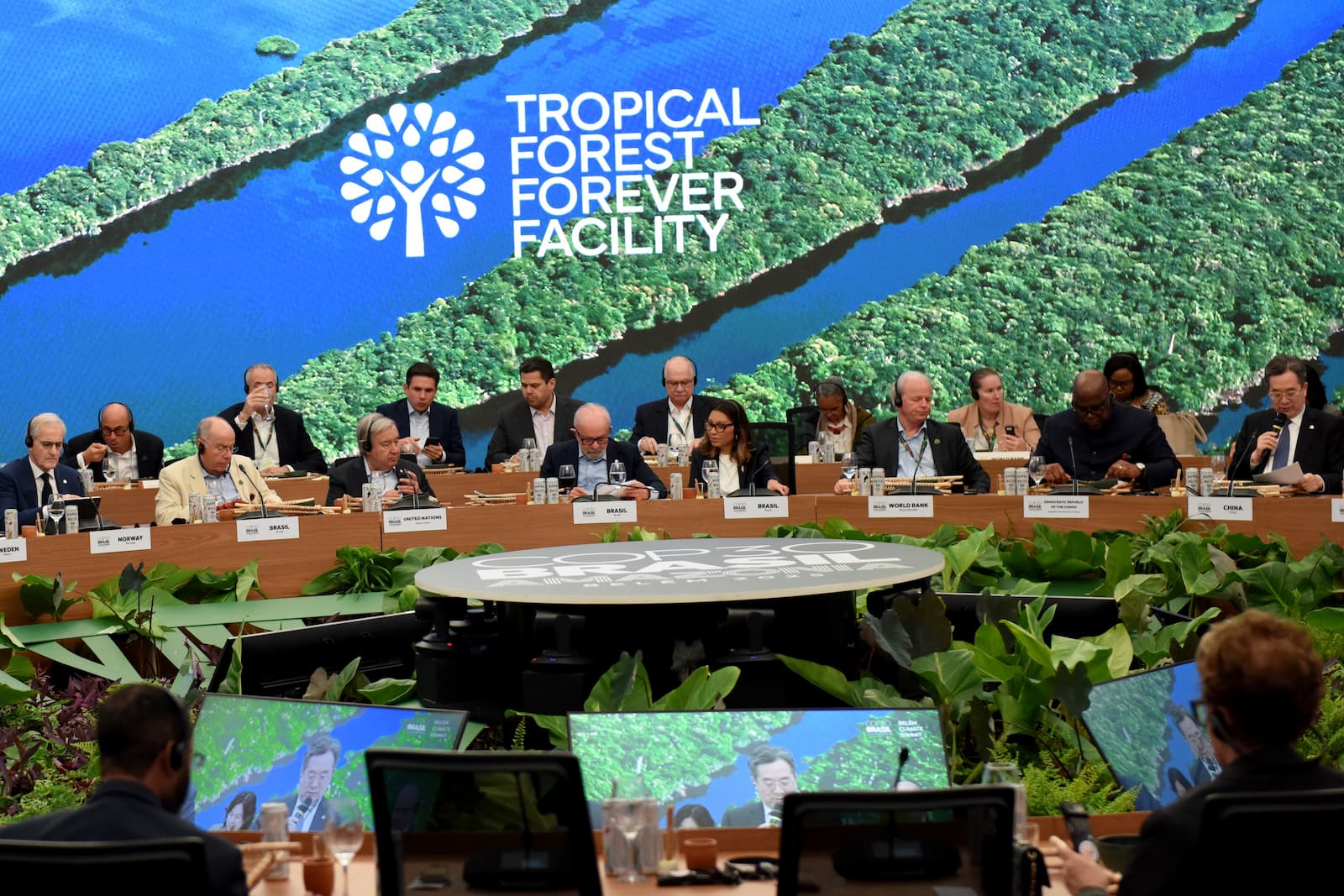
The Tropical Forest Forever Facility (TFFF) was launched at COP30 in Belém in November 2025, with President Lula and Environment Minister Marina Silva presiding over the announcements. A year later, at COP31 in Antalya, it is still trying to prove that its model can work. Despite talk of a retreat, the reporting points to hesitation rather than formal withdrawals: many wealthy governments never committed, and several of those who did attached conditions.
The idea, and the gap
The facility’s design is ambitious. It aims to raise US$25 billion from governments and US$100 billion more from private investors, then pay countries each year from the returns for every hectare of tropical forest they keep standing. At least 20 per cent of the money is meant to go to Indigenous Peoples and local communities.
The money is running behind. The fund has mobilised $8.2bn so far, mostly as conditional loans, leaving it $1.8bn short of a $10bn target for this year. That target is not arbitrary: Norway will not sign its $3 billion loan until sponsor pledges reach $10 billion by the end of 2026. Delegates had speculated that Antalya might deliver a windfall, but only $88m from philanthropies emerged as new contributions, and several countries simply repeated earlier pledges.
Why the money is slow
Rich-country budgets. At Belém, Global North countries were hesitant to commit funds, often citing domestic budget constraints. That is the backdrop to every other problem.
Doubts about the financial model. The fund is built on leverage. A policy analysis from the Heinrich Böll Foundation notes that for every dollar from donor countries, the fund borrows four from private investors. Payouts depend on markets: countries are paid only if returns stay above the fund’s own costs. Critics argue this makes the promised payments hard for forest countries to budget around, and the same analysis says the model has been under revision behind closed doors for much of a year. Political economist Max Alexander Matthey has warned that the fund can no longer deliver the $4 per hectare it first promised, even in a best-case scenario.
Politics at home. Germany shows how fragile a pledge can be. A CDU budget spokesman said he would push to block Germany’s €1 billion commitment, arguing that it was hard to justify while Germans face spending cuts. The scare has mostly passed: the Bundestag budget committee approved the 2027 budget with the TFFF funds, including a first payment of €126.6 million. The full Bundestag vote is still due this week. The episode mattered because, according to advocacy groups, Germany’s involvement is seen internationally as a seal of approval for the fund.
Political economist Max Alexander Matthey
Absent or hesitant big players. China, despite supporting the initiative at its launch, has not yet made a financial pledge. Brazil also courted Japan, South Korea and China without public commitments, and the US under Donald Trump was seen as unlikely to pledge. The UK stalled in July, before saying in September that it intends to invest £400 million through a loan, subject to due diligence.
NGO and civil society criticism. The Global Forest Coalition rejects the model, arguing that private investors only invest when profits are relatively certain. Others, including Human Rights Watch, pushed for the Indigenous earmark, which was added in response to demands from territorial leaders and civil society.
The strongest supporters
Norway is the anchor. It co-chairs the fund with Brazil and holds the biggest pledge, at $3 billion. Its commitment comes with a cap: Norway said it is ready to contribute up to 20% of the total. Because its share currently exceeds that, at 36%, Norway needs others to catch up.
Brazil and Indonesia are the tropical forest countries that put in their own money, $1 billion each at launch.
Germany (€1 billion) is the second-largest sponsor. Notably, the pledge is non-repayable, with no expectation of returns, unlike most loans in the fund.
France pledged roughly €500 million, tied to requirements including regular evaluation, independent scientific analysis and transparency.
The Netherlands was Antalya’s headline, pledging up to $500 million over ten years.
Canada pledged up to $393m over four years, announced by Prime Minister Mark Carney at a summit in Manila.
The UK (£400 million, a loan) and Luxembourg also belong on the list.
Beyond money, 66 countries plus the EU have endorsed the facility, though endorsement and funding are very different things.
The outlook
Two things can be true at once. The TFFF has grown from about $6.7 billion at the close of COP30 to over $8 billion, and Dutch, Canadian, British and German commitments are real. But the facility has roughly six weeks to find the remaining $1.8 billion, and no forest payments have been disbursed yet. Supporters say the fund is already planning to invest its initial sponsor capital and make first payments next year, but critics warn the payouts will be smaller and slower than promised.
If Norway’s deadline is missed, the TFFF will not necessarily die, but it will lose its largest backer’s signature at the moment it needs momentum most. The next decisive date is 31 December, with the Bundestag’s final budget vote this week as the first test.
Figures as reported on 25 November 2026; pledges and parliamentary votes may still change.