


Wind Power Goes to Sea: The Rotor-Sail Tanker Spotted in Guanabara Bay
When we think of renewable energy in Brazil, we picture wind farms on the Northeast coast or solar panels on rooftops. Rarely do we picture a tanker. Yet on a grey morning crossing Guanabara Bay, that is exactly where I found it: wind power, mounted on the deck of a ship.
eyesonbrasil
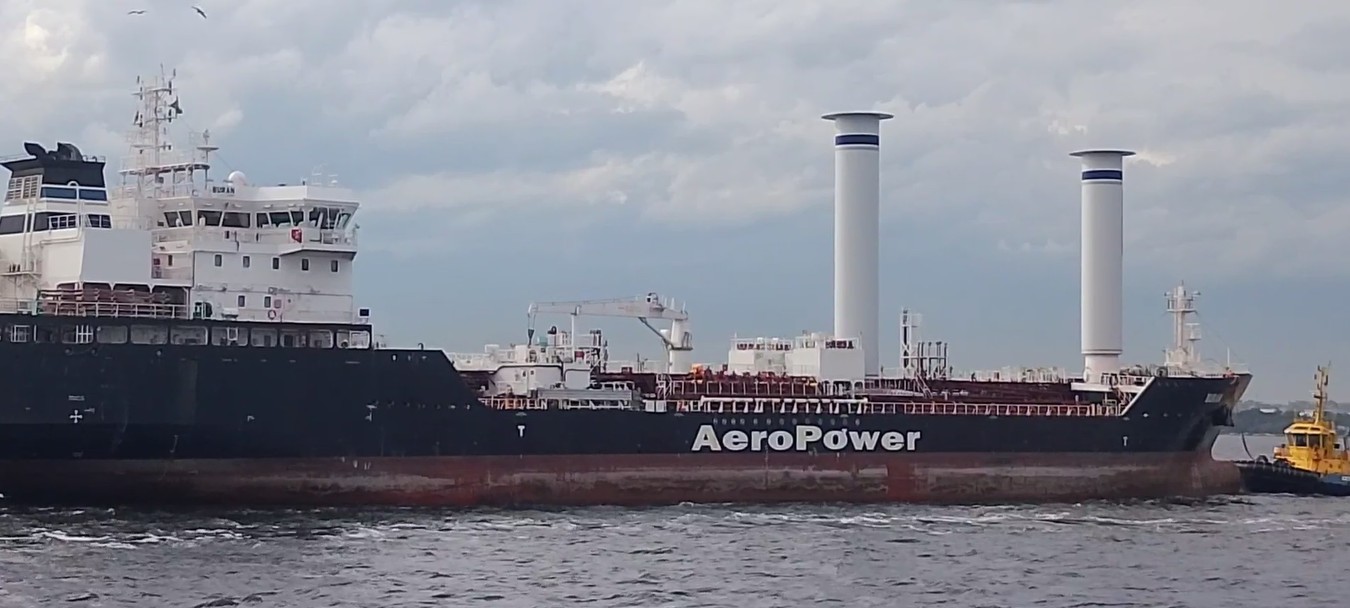
Earlier this week, on the ferry from Ilha de Paquetá to Praça XV, a black-hulled tanker slid past with two enormous white cylinders rising from its deck, turning slowly. The hull carried a single word: AeroPower. A name on the bridge wing read Buran. It looked like something from a science-fiction film. It is, in fact, one of the more practical ideas in shipping today.
What are those towers?
They are rotor sails, also known as Flettner rotors, named after the German engineer Anton Flettner, who experimented with them in the 1920s. They are tall vertical cylinders, spun by electric motors, that harvest wind without any fabric at all.
How a spinning cylinder pushes a ship
The trick is the Magnus effect, the same physics that makes a spinning football curve in flight.
- A motor at the base rotates the cylinder. Its surface drags the surrounding air along with it.
- On one side, the spin adds to the wind speed; on the other, it subtracts. Faster air means lower pressure.
- The cylinder is pushed toward the low-pressure side, at right angles to the wind. With a crosswind, that push becomes forward thrust.
- A flat disc on top stops air from spilling over the end, and a control system adjusts the spin speed and direction as the wind shifts.
Because of this, a rotor ship can sail closer to the wind than a traditional sailing vessel.
Meet the AeroPower fleet
Buran is an 18,500-dwt chemical tanker owned by the UK-based Union Maritime. It was the first of 34 wind-assisted vessels the company has on order, all under the AeroPower brand. It is equipped with two Norsepower Rotor Sails, and it set out on its maiden voyage from Taizhou, China, to Singapore in 2025. Seafarers for the fleet are even trained on a simulator at Solent University in Southampton, which models rotor-sail behavior in bad weather and tight maneuvering.
Is the wind actually driving the ship?
Only partly, and that is the honest answer. Rotor sails are hybrid technology: the engine and propeller remain the main source of propulsion, and the rotors take some of the load.
- Union Maritime expects wind to supply up to 10% of each vessel’s annual energy needs.
- For Buran, the projection is about 300 tonnes of fuel and 940 tonnes of CO₂ saved per year.
- Industry-wide, rotor sails are generally reported to deliver fuel savings of roughly 5 to 20%.
These are owner and supplier projections, not measured results, and real savings depend on the route and the winds. Regulation is part of the appeal too: Union Maritime says the installation earns Buran the maximum reward factor under the EU’s FuelEU Maritime rules.
Why they turned so slowly in the bay
Rotors spin fastest when there is useful wind from the side. In a sheltered bay, at low speed and near a busy port, slow or idling rotors are unsurprising. The ship’s own slow speed also reduces the apparent wind.
A Brazilian connection
This is not the first time the technology has touched Rio’s waters. In 2023, Vale’s ore carrier Sea Zhoushan, the first iron-ore vessel with rotor sails, arrived at the Ilha Guaíba terminal in Mangaratiba, carrying rotors about 24 meters tall each. Vale reported expected efficiency gains of up to 8% and a cut of up to 3,400 tonnes of CO₂-equivalent per ship per year.
Why it matters
Most ships today still run on fossil fuel, and shipping is hard to electrify. Rotor sails will not end that on their own, and a 10% saving is modest. But they are mature, retrofittable and already at sea, a reminder that decarbonization is not only about what happens onshore. Sometimes the future is parked in plain view in Guanabara Bay, spinning gently in the breeze.
Sources
- Seatrade Maritime: First of 34 Union Maritime wind-assisted vessels sets sail
- Marine Link: Union Maritime launches wind-assisted ship
- Solent University: Wind-assisted tanker training
- Mining Magazine: Vale sails lower emissions
- Click Petróleo e Gás: First rotor-sail ore carrier arrives in Rio de Janeiro