



Why Dutch Companies Keep Choosing Brazil

eyesonbrasil
Amsterdam, September 21, 2026 – At first glance, the Netherlands and Brazil could hardly look more different — a nation of 17 million squeezed into land it partly reclaimed from the sea, and a continent-sized country of over 200 million people with the world’s largest tropical forest inside its borders. Yet Dutch companies have been quietly building some of their biggest, longest-running international operations in Brazil for decades. The relationship isn’t incidental. It’s built on a recurring pattern: Brazil has an enormous, resource-rich market with real gaps to fill, and the Netherlands has spent centuries specializing in exactly the things that fill them — trade logistics, water and agriculture expertise, and global food and beverage distribution.
Heineken: chasing a beer market that outgrew expectations
Heineken’s move into Brazil is one of the more dramatic bets a Dutch multinational has made in Latin America. The company entered the market in 2010 by acquiring the beer division of the FEMSA Group, then transformed its position in 2017 by buying Kirin Company’s Brazilian subsidiary, Brasil Kirin, in a deal worth roughly €664 million, which made it the second-largest brewer in Brazil.

What kept Heineken pouring money in wasn’t just market share — it was watching Brazilian demand shift toward premium beer faster than almost anywhere else Heineken operates. By 2025, the company had invested roughly 6 billion reais in the country over six years, culminating in a 2.5-billion-reais greenfield brewery in Passos, Minas Gerais — Heineken’s first ground-up build in Brazil, positioned to improve distribution efficiency into Brazil’s main consumption hub, the Southeast region. Brazil’s importance to the company isn’t a minor footnote either: the country grew from the 17th-largest market for the Heineken brand globally, five years earlier, to the leading one. As CEO Dolf van den Brink put it when opening the Passos plant, Brazil is “one of the most dynamic beer markets in the world,” and the investment reflects confidence in its growth potential.
Rabobank: bringing 125 years of farm-cooperative DNA to Brazilian agriculture
If Heineken came to Brazil for consumers, Rabobank came for farmers. The bank’s roots go back to 1890s Dutch farming cooperatives built on a simple idea: pool local savings so farmers who couldn’t get credit anywhere else could invest in their land. Rabobank’s presence in Brazil began in 1989 with a representative office, was formally authorized as a commercial bank in 1995, and started serving farmers directly with rural financial products in 2004.

The motivation is almost definitional — Rabobank describes agribusiness as being “in its DNA,” and Brazil, as one of the world’s largest agricultural producers and exporters, is simply where that specialty has the most room to operate. Today the bank runs fourteen branches across states including Bahia, Mato Grosso, Minas Gerais, and São Paulo, and it has increasingly tied its lending to sustainability outcomes — for instance, backing a $16 million green deal with Scheffer aimed at doubling the area of certified regenerative agriculture, and structuring sustainable-agriculture financing deals with a partner fund aimed at forest protection and pasture recovery in Mato Grosso.
Vopak: securing a foothold on Latin America’s busiest trade route
Royal Vopak’s story in Brazil is about geography as much as commerce. As the world’s largest independent tank storage operator, headquartered in Rotterdam, Vopak built its entire business model around holding strategic positions along major global trade routes — and Brazil’s ports, especially Santos, sit directly on one of the busiest routes for ethanol, fuel, and chemical shipments in the Western Hemisphere.
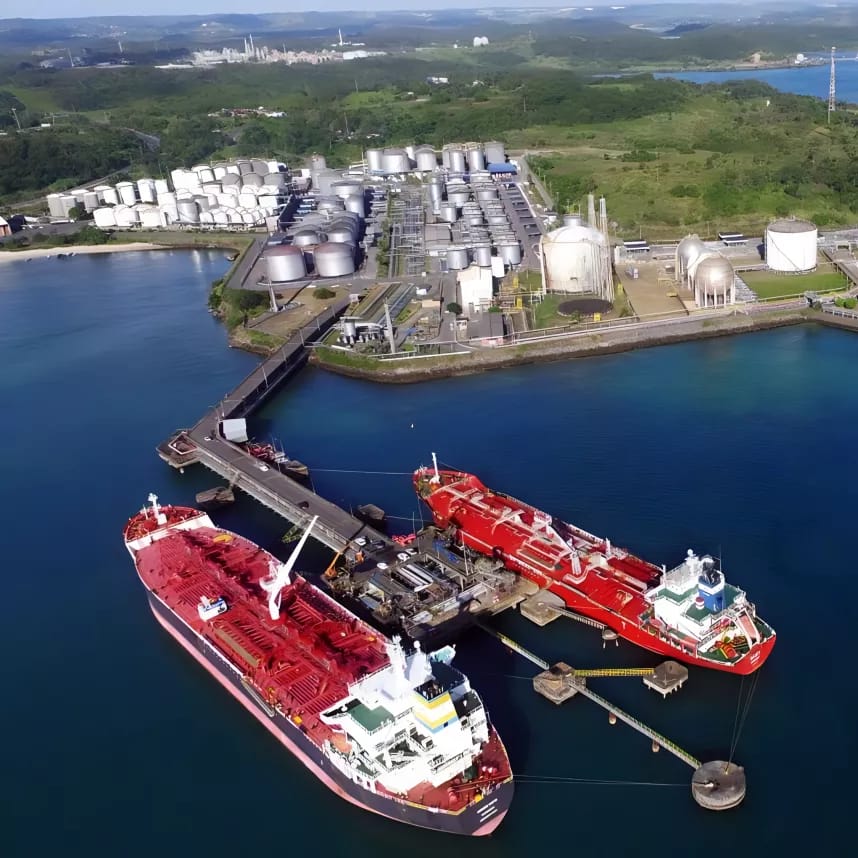
Vopak first moved into the Brazilian Northeast in 2007, acquiring a terminal in Suape, one of the country’s fastest-growing ports, to strengthen its position in clean petroleum products and the expanding ethanol trade. It kept expanding from there: by 2017, Vopak was adding 16 new tanks and 61,000 cubic meters of capacity to its Alemoa terminal in the Port of Santos — Latin America’s largest port — primarily to support ethanol exports and fuel imports, and further expansions followed into the 2020s. For Vopak, Brazil wasn’t a market to win over with a product; it was infrastructure to own because of where the country sits on the map.
What’s pulling Dutch companies to Brazil now
Beyond these individual stories, there’s a structural logic drawing new waves of Dutch investment. Dutch trade officials point to renewable energy, the circular economy, smart logistics, water management, agritech, and green hydrogen as sectors where Dutch expertise meets fertile ground in Brazil, and momentum is building around a possible EU–Mercosur trade agreement that could make assets Dutch companies already hold in Brazil suddenly more competitive and profitable. Water security is another draw: with Brazil’s 2020 Sanitation Law pushing toward universal water access, Dutch water-technology companies have taken increasing notice of the opportunities opening up in Brazilian sanitation.
None of this means Brazil is easy. The same guides that talk up the opportunity are candid about the friction — incomplete land registration, environmental compliance gaps, and restrictions on foreign land ownership among them, alongside a new 10% withholding tax on dividends sent back to foreign shareholders that took effect January 1, 2026. As one guide for foreign investors bluntly summarizes the local wisdom: Brazilians often say the country “is not for amateurs.”
What ties Heineken, Rabobank, and Vopak together isn’t sector — it’s timing and specificity. Each arrived when Brazil had a concrete, structural need — beer demand outgrowing supply, farmers needing patient long-term capital, trade routes needing storage — that happened to match a capability the Dutch had spent generations refining. That’s arguably the real lesson for the next wave of companies eyeing Brazil: the market rewards distinctive expertise applied to an actual gap, not simply showing up because the numbers are big.