


Two Speeches, One Fractured Alliance

Lula, Trump, and Brazil’s Fraught Election Season
eyesonbrasil
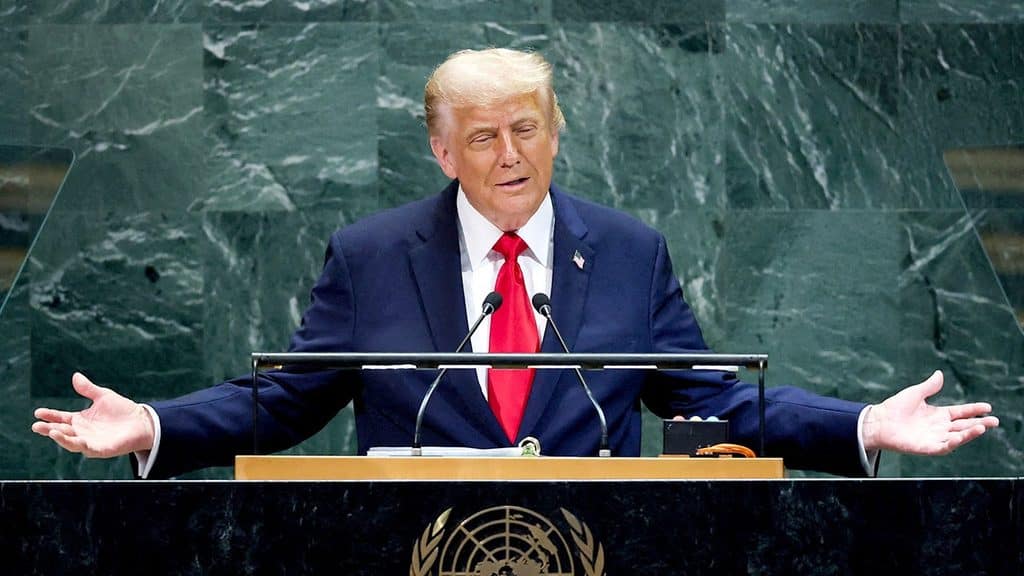
Amsterdam, September 22, 2026 – When Luiz Inácio Lula da Silva stepped to the podium to open the UN General Assembly’s 81st session on September 22, 2026, he wasn’t just delivering Brazil’s traditional opening address — he was speaking, twelve days before his own re-election bid, directly to the man scheduled to follow him. Lula warned against interference in Brazil’s upcoming election, using the speech to defend the country’s sovereignty amid tensions with the United States.
Two Visions, Back to Back
Speaking just before his October 4 bid for a fourth non-consecutive term, Lula said Brazil would not let domestic or foreign actors undermine the vote. He didn’t name Trump directly, but the target was unmistakable: he pointed to a resurgence of “hegemonic ambitions” and foreign interference in elections across Latin America, insisting Brazil “does not belong in anyone’s backyard” and that carving the world into spheres of influence was outdated thinking.
He closed with a line aimed squarely at Jair Bolsonaro, the imprisoned former president, and by extension his son and political heir: Lula said Brazil would not allow enemies of democracy, at home or abroad, to override the popular will, adding that Brazilian democracy belongs to Brazilians and that the country remains sovereign.
He also took aim at the US naval buildup off Latin America, saying the region needs cooperation against arms and money flows fueling organized crime rather than aircraft carriers patrolling its waters — a reference to a proposal he says he personally handed the US president.
Trump spoke next, as protocol dictates for the host nation. The broader contrast between the two leaders’ worldviews has been stark all week: Lula called for decarbonizing economies, protecting forests, and supporting the energy transition through technology transfer, while the American president has mocked climate warnings as reheated doomsaying.
Underneath the diplomatic language sits a year of escalating economic pressure. Since July 22, 2026, certain Brazilian goods have faced an extra 25% tariff under Section 301 of the US Trade Act, with exemptions for aircraft, coffee, beef and orange juice, plus a separate 12.5% forced-labor duty affecting Brazil and dozens of other economies since July 24 — together covering roughly 37.5% of Brazil’s US-bound exports, according to Brazil’s trade ministry. An earlier round of emergency tariffs was struck down after the US Supreme Court ruled against them in February 2026.
Election Integrity: A Race Too Close to Call
Brazil votes October 4, with a possible runoff October 25. The contest is Lula versus Senator Flávio Bolsonaro, and it is razor-thin. Polling from mid-September 2026 shows a statistical dead heat: Datafolha put a hypothetical runoff at 46–44 for Lula, while AtlasIntel/Bloomberg had Bolsonaro marginally ahead, 47.2–46.8. A separate first-round Datafolha poll from September 17 put Lula at 39% and Bolsonaro at 36%, a technical tie within the margin of error.
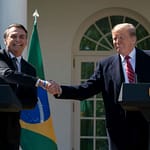
Lula has raised his own alarms about interference — not just from Washington. He told CNN that Brazilian intelligence has flagged suspected interference in the race, including the use of artificial intelligence, according to reporting by the Minas Gerais daily O Tempo. On the trail, he told a rally in Ceilândia that he would fly to New York to tell Trump personally not to interfere in Brazil’s election. Brazil’s Foreign Ministry has said no formal bilateral meeting was scheduled, though the two leaders were expected to cross paths as they did the year before.
Trump, Flávio Bolsonaro, and the Question of Endorsement
Trump’s relationship with the Bolsonaro family is a central undercurrent of this election. Brasília has accused Washington’s tariff escalation of being politically motivated — an attempt to boost Flávio Bolsonaro’s standing as the son of the former president Trump considers an ally. Trump has previously called the prosecution of Jair Bolsonaro a “witch hunt” that should end immediately, writing that he “knew and dealt with” the former president and “respected him greatly.”
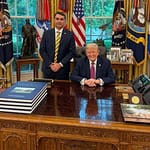
Flávio has leaned into that connection. He met privately with Trump at the White House in May 2026, along with his brother Eduardo and a Brazilian journalist, in a meeting lasting over an hour. During that visit he said Trump had asked no explicit question about the meeting’s political purpose — Flávio himself later clarified there had been “no statement of support, nor should there have been one,” saying he would never ask for one. Still, he has repeatedly used his family’s ties to Trump to try to shore up a campaign shaken by scandal. At CPAC in Texas, he promised an improved version of his father’s presidency, saying “Bolsonaro 2.0” would follow the success of “Trump 2.0,” while insisting Brazil needs free and fair elections to preserve the popular will.
So while Trump has not issued a formal, explicit endorsement of Flávio Bolsonaro’s candidacy, his sustained defense of Jair Bolsonaro, his tariff pressure tied to that prosecution, and his White House meetings with Flávio have all been read in Brazil — and framed by Lula’s own campaign — as thumbs on the scale.
The Banco Master Scandal Looms Over Everyone
Complicating the race further is Brazil’s largest-ever banking fraud case, which has touched figures across the political spectrum. The scandal began when Brazil’s Central Bank blocked a proposed acquisition of Banco Master, triggering an investigation that has since ensnared two Supreme Court justices, a senator, a former governor, and bank regulators — and, more recently, Flávio Bolsonaro himself.
Banco Master’s controlling shareholder, Daniel Vorcaro, was first arrested in November 2025 at a São Paulo airport while trying to leave the country on a private jet, released, then re-arrested in March 2026 as the investigation — dubbed Operation Compliance Zero — widened. The probe has reportedly touched a roughly $26 million film-financing deal between Vorcaro and Flávio Bolsonaro, along with Centrão power broker Ciro Nogueira and senior Central Bank officials.
The political fallout has cut in Lula’s favor so far. The scandal has boosted support for the incumbent while complicating Flávio Bolsonaro’s campaign, according to legal analysis of the case’s political impact. Corruption has risen to become the second-highest-ranking voter concern in Brazil, according to Quaest polling from early 2026, with the Master fallout appearing to sway voter priorities heading into the cycle.
The Bigger Picture
What emerges is a race shaped less by policy debate than by dueling narratives of legitimacy: Lula casting himself as the defender of Brazilian sovereignty against foreign meddling and domestic “enemies of democracy,” and Flávio Bolsonaro leaning on his ties to a US president who has made no secret of his sympathy for the Bolsonaro family’s grievances — even as a sprawling bank-fraud investigation shadows his own campaign. With the vote a matter of weeks away and polls locked in a statistical tie, both the UN stage and the unresolved Banco Master probe are likely to keep shaping the campaign’s final stretch.
This is a fast-moving story — polling, tariff status, and the Banco Master investigation are all still developing as Brazil’s election approaches.