


132 years of Big Business, Big Politics, Big Culture And Power One table in Rio de Janeiro

eyesonbrasil
Rio de Janeiro, 1 September 2026–Walk down Rua Gonçalves Dias in downtown Rio de Janeiro and push open the heavy door of the Confeitaria Colombo, and you don’t just step into a pastry shop — you step into a living piece of history.
Since it opened on 17 September 1894, founded by two Portuguese immigrants, Joaquim Borges de Meireles and Manuel José Lebrão, this establishment has been the window through which one can trace Rio’s economic and social development — 132 years running, right up to today.
The house was born in the euphoria of the young Brazilian Republic, when coffee was the engine of the nation’s wealth and Rio wanted to remake itself in Europe’s image.
That ambitious self-image is still visible in the interior: enormous crystal mirrors, shipped in by boat from Antwerp, framed by friezes of precious jacaranda wood; Italian marble counters; furniture hand-carved by the craftsman Antônio Borsoi.
Between 1912 and 1918 the interior was further embellished with Art Nouveau touches, and in 1922 a second floor was added — a tea salon crowned with a stained-glass ceiling that today forms part of the Cristóvão restaurant. Every stone and every mirror tells the same story: a trading city determined to show the world its wealth.
But the Colombo’s real capital was never just the pastries. It was the table itself, where businessmen, politicians, writers and artists met informally, far from the official halls of power. The poet Olavo Bilac came here, as did the composer Chiquinha Gonzaga and the future maestro Villa-Lobos. The writers Machado de Assis and Lima Barreto, chroniclers of the Rio of their day, stirred their coffee here while commenting on the city changing outside the windows.
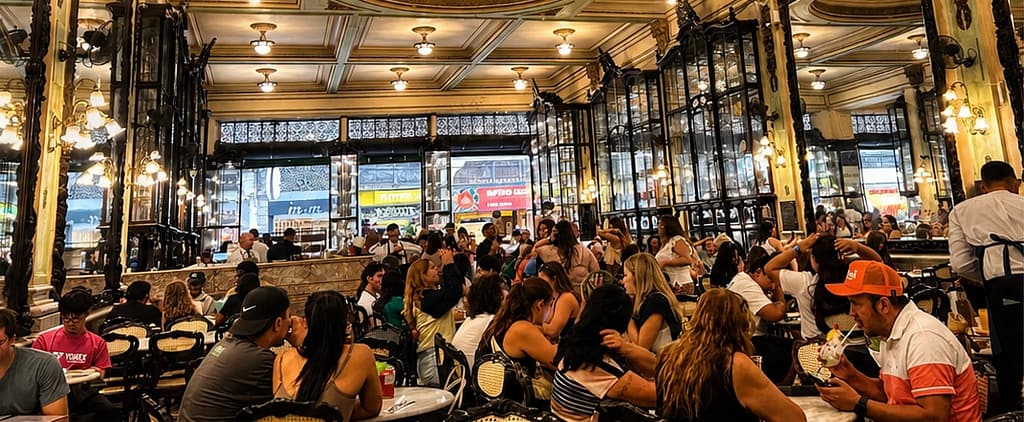
The jurist and abolitionist Rui Barbosa aired his ideas here too. The Colombo was even jokingly dubbed “a branch of the Brazilian Academy of Letters” — a place where cultural authority carried as much weight as political power.
That density of power eventually drew heads of state as well. President Getúlio Vargas, and later Juscelino Kubitschek, were seen here, along with foreign guests such as King Albert I of Belgium and Queen Elizabeth II. At the very same marble tables where merchants sealed contracts, political alliances were forged and international ties maintained — business, power and culture, literally at one table.
The twentieth century was not always kind: the relocation of the capital to Brasília in 1960, and decades of decline in the historic center, temporarily dimmed the shine. A branch in Copacabana, opened in 1944, kept the name alive until 2003. Yet the Colombo survived, precisely because it had never been merely a restaurant, but an institution in which Rio recognized itself.
Today, 132 years after it opened, the Confeitaria Colombo is a protected landmark and a tourist draw, but the old logic still holds: anyone in Rio who wants to do business, taste culture, or brush up against power still sits down at a table — preferably beneath the mirrors from Antwerp
eyesonbrasil