Brazil holds roughly 12% of the world’s freshwater. And yet its largest city, São Paulo, has spent recent years lurching between drought-driven water rationing and catastrophic flash floods — a contradiction that has turned the country into one of the most active proving grounds anywhere for a very Dutch export: knowing how to live with water rather than fight it blindly.
Brazil’s water sector faces mounting pressure from climate change, rapid urbanisation and long-standing infrastructure gaps, and despite abundant freshwater resources, prolonged droughts, extreme rainfall and rising demand are placing growing strain on urban water systems. Into that gap has stepped a wave of Dutch technology firms, engineering consultancies and entrepreneurial startups — some centuries removed from the polders of Zeeland, others founded just a few years ago in Delft or Leeuwarden — all selling a version of the same hard-won expertise: how a country that sits below sea level learned to manage water precisely, digitally, and continuously.
Case One: Teaching São Paulo’s Pipes to Talk
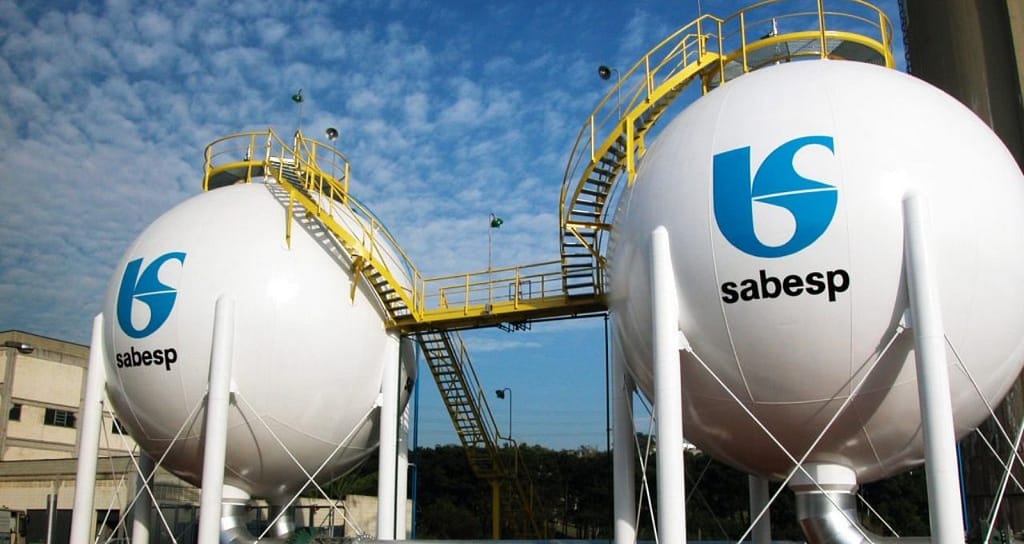
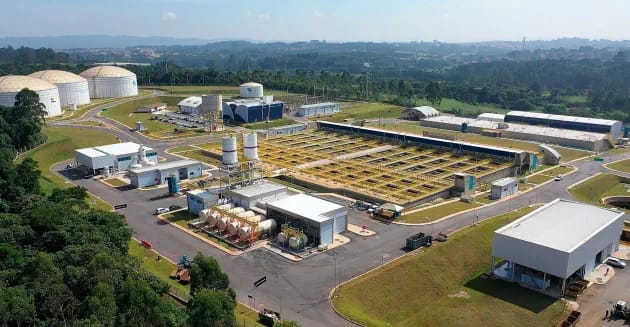
São Paulo relies on an extensive drinking water system operated by SABESP, and the city faces significant water losses due to ageing and complex networks, with climate variability and rising demand further increasing pressure on daily operations.
Enter Flowless, a Dutch-Palestinian company specializing in AI-driven network monitoring. Rather than sending crews to physically hunt for leaks across thousands of kilometers of piping, Flowless’s AI-powered, data-driven monitoring enabled targeted operational improvements for SABESP and helped reduce water losses by around 1,000 cubic meters per month — water that would otherwise vanish into the ground before ever reaching a tap. It’s a small number stacked against a giant utility, but it illustrates the model: Dutch software doesn’t replace Brazilian infrastructure, it makes the existing infrastructure smarter.
Flowless isn’t working alone. Alongside it, several other Dutch solution providers are part of this transition, offering digital tools that help utilities manage their networks more effectively. Among them: Aquasuite, developed by Haskoning, which generates a system-wide overview of drinking water and wastewater operations, drawing on data already available in networks and using predictive models to anticipate changes in demand, automatically adjust pumping and treatment processes, and stabilise system performance — helping operators maintain consistent service levels, manage energy use more efficiently, and detect deviations early.
And then there’s the leak-detection specialist HULO, which focuses on identifying localised leaks through high-frequency data analysis and digital twin technology, using a statistical approach to trace subtle or emerging losses that may not appear through conventional inspection. Between the three, São Paulo’s water network is quietly becoming one of the more heavily instrumented urban water systems in the Southern Hemisphere — not through a single mega-project, but through a layered stack of Dutch monitoring, modeling and prediction tools bolted onto Brazilian pipes.
Case Two: Arcadis and Fifteen Years of Betting on Brazil
If the startups represent the newest wave, Arcadis represents the deepest roots. The Arnhem-headquartered engineering giant has been active in Brazil for well over a decade, and its trajectory tells its own story about how the relationship has matured — from pure infrastructure-building toward smart, data-led asset management.
Back in 2010, Arcadis’s Brazilian arm, Arcadis Logos, signed onto a consortium with a local firm for the São Francisco River Integration Project, a US$42 million water management contract with Brazil’s Ministry of National Integration aimed at reducing chronic water shortage in Brazil’s northeast through 720 kilometers of channels, aqueducts, tunnels and reservoirs, pumping up to 127 cubic meters of water per second from the São Francisco River into arid basins. That same year, it also won a separate $54 million contract with SABESP for wastewater infrastructure expansion in metropolitan São Paulo.
By 2014, the relationship had scaled further: Arcadis Logos signed two more SABESP contracts — one worth $12.8 million for project management of water and wastewater systems across a 5,115 km² area serving 16 million people, and another worth $39 million for SABESP’s water-loss reduction program, a $440 million initiative aiming to cut the utility’s physical water-loss rate from 26% down toward 13% by 2019.
Fast forward to April 2025, and Arcadis is still there — only now the emphasis has shifted decisively toward digital tools. Arcadis was selected by SABESP for two major strategic contracts in São Paulo, combining digital asset-management tools with deep-water treatment expertise to support the expansion of Brazil’s largest wastewater treatment plant and to oversee planning for SABESP’s Universal Water Supply and Sewerage Program, together securing water infrastructure for more than 28 million people across 375 municipalities. Arcadis’s own CEO framed it as proof of concept for the digital-plus-engineering formula the Dutch water sector has been refining for years: bringing together expertise across resilience and intelligence business areas to enhance infrastructure and protect communities at scale.
Case Three: An Orange Pavilion in the Middle of São Paulo
Individual company wins are one thing. But Brazil has also become a fixture on the institutional map of Dutch water diplomacy — the deliberate, government-backed matchmaking that has made the Netherlands punch so far above its size in this sector globally.
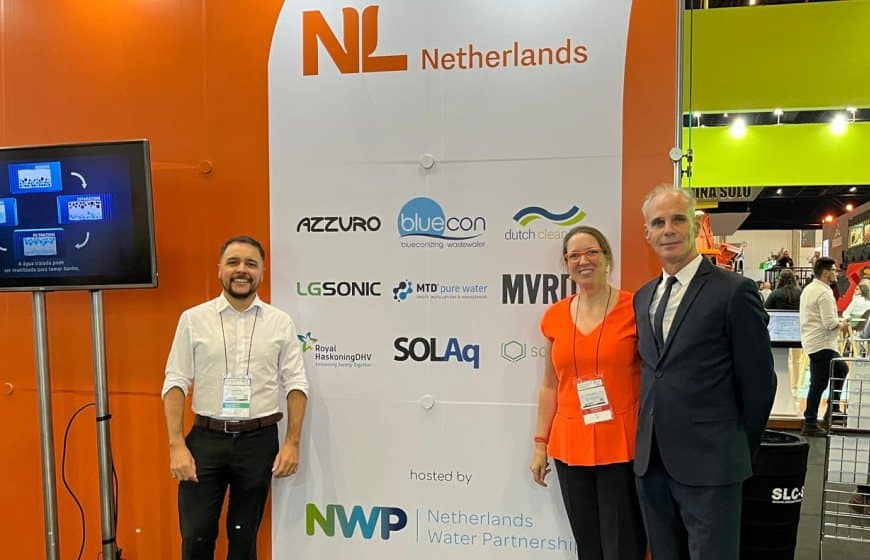
Every year, the Netherlands Water Partnership (NWP), working with the Dutch Consulate-General in São Paulo, sets up what it calls the “Netherlands Lounge” at Fenasan — Latin America’s largest technical-commercial event on environmental sanitation, organised by AESabesp, the Association of Engineers of SABESP. The 2025 edition, held in October, drew roughly 20,000 attendees — engineers, chemists, biologists, technicians, researchers and business leaders working across environmental sanitation in both public and private sectors.
It’s more than a trade-show booth. Eight Dutch organisations shared the joint stand that year, benefiting from shared logistics, collective branding and dedicated matchmaking support, with many partnerships now moving toward pilot projects, joint bids and long-term service agreements — new leads generated through matchmaking facilitated by NWP, the Dutch Consulate-General in São Paulo, and the Netherlands Business Support Office in Porto Alegre. The Dutch Consul General framed the logic bluntly in the mission’s welcome materials: by connecting Dutch technology with Brazilian ambition, the two countries can jointly deliver solutions that set global examples, whether in building resilient cities, securing clean water for all, or ensuring sustainable industrial water use.
Why Brazil, Why Now
The pattern across all these cases is consistent, and it’s not accidental. Dutch water expertise has historically traveled to wherever climate stress meets large, complex urban water systems — from Wuhan to São Paulo to Miami and New Orleans, coastal and riverine cities worldwide have been hiring Dutch companies to combat rising water risk, drawing on a domestic industry forged by centuries of living below sea level. Brazil checks every box that makes it attractive: a national champion utility (SABESP) operating at a scale few countries can match, real and growing climate volatility, and — critically — political and commercial appetite to modernize rather than simply rebuild.
What’s shifted over fifteen years is the type of expertise being exported. The Arcadis of 2010 was pouring concrete and laying channels; the Arcadis of 2025 is deploying digital asset management tools alongside that same engineering muscle. Flowless, HULO and Aquasuite skip the concrete altogether and sell pure intelligence — sensors, algorithms and digital twins layered onto infrastructure that already exists. Between the legacy engineering firms and the newer AI-driven monitoring startups, Dutch entrepreneurship in Brazil now spans the full spectrum from mega-infrastructure to software-as-a-service — a bet that the next phase of water security in Brazil’s cities will be won less by pipe diameter than by data